The Simple Departure: Emily Dickinson's "The Dying Need But Little, Dear,—"
First published in 1890, years after her death, "The Dying Need But Little, Dear,—" captures the profound, quiet intimacy that Emily Dickinson is known for. As one of America’s most influential poets, Dickinson lived a famously secluded life in Amherst, Massachusetts, producing thousands of poems that often explored the boundaries of life, death, and faith. This particular work is a masterclass in domestic minimalism, stripping the monumental transition of death down to its most basic, tactile needs.
The Poem
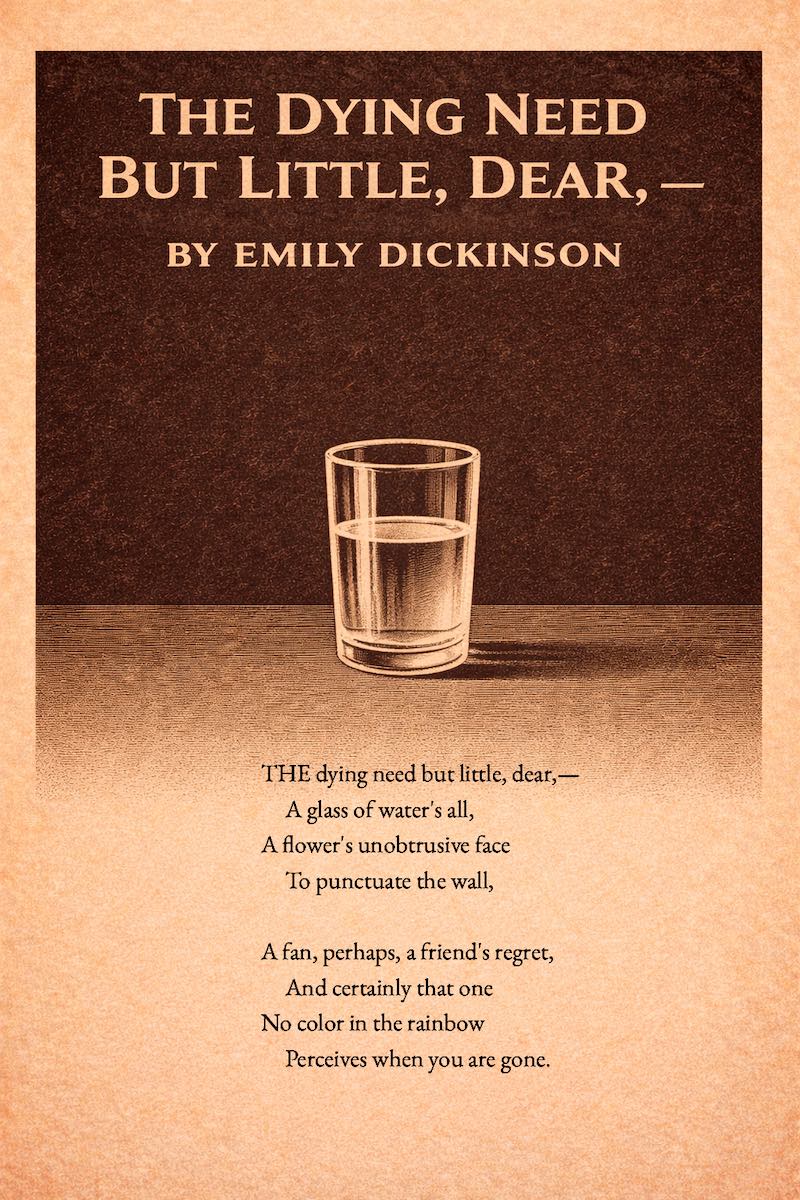
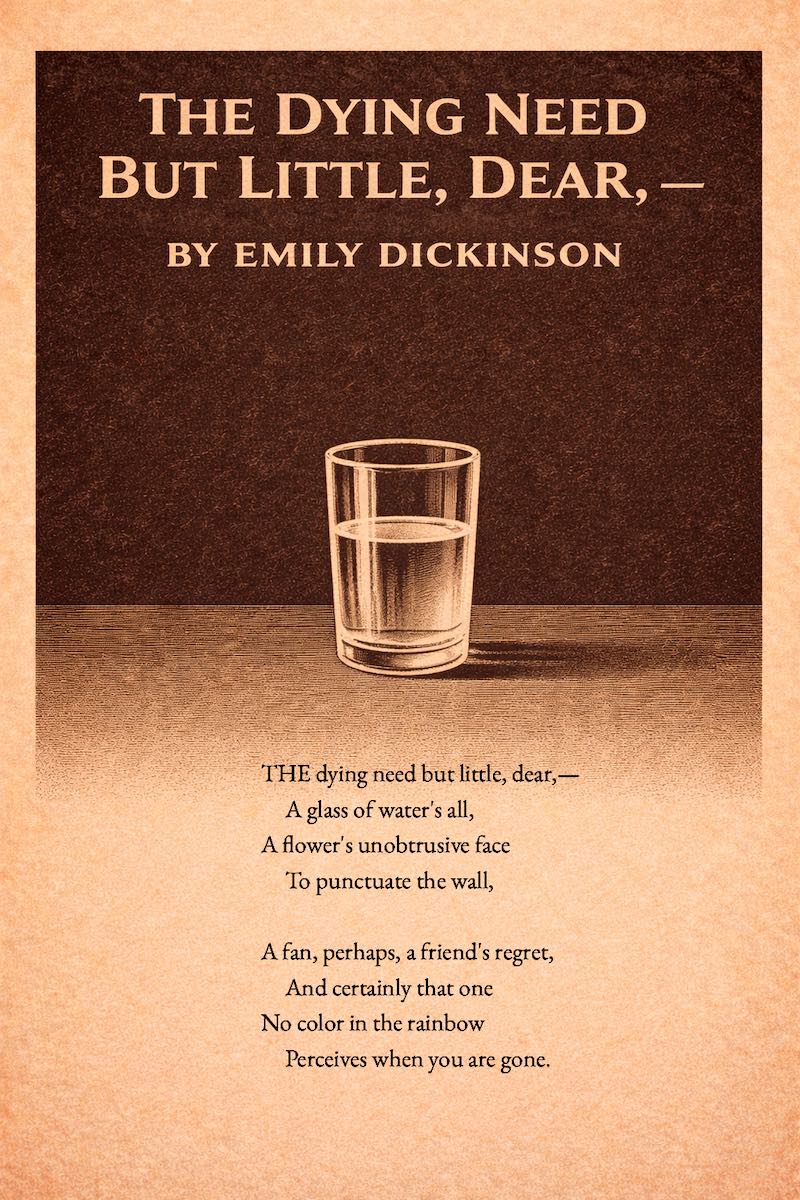
THE dying need but little, dear,—
A glass of water’s all,
A flower’s unobtrusive face
To punctuate the wall,
A fan, perhaps, a friend’s regret,
And certainly that one
No color in the rainbow
Perceives when you are gone.
The Insight: The Simple Departure
The poem offers a striking summary of death as an act of stripping away. By suggesting that the transition only requires a "glass of water" and a "flower's unobtrusive face," Dickinson shifts the focus from the grandiosity of the afterlife to the humble, physical reality of the final moment.
Dickinson utilizes a catalog of small, ordinary objects to anchor the poem in reality. The "glass of water" and the "fan" represent the physical comforts needed for the body, while the "flower's unobtrusive face" provides a quiet visual anchor for the eyes. By focusing on these modest elements, Dickinson demystifies the terrifying vastness of death, wrapping it instead in the familiar, tender rhythms of domestic care. The sparse punctuation and trademark dashes create physical pauses in the reading, mimicking the slow, deliberate breaths of a quiet bedroom at the end of life.
The core philosophical "takeaway" is found in the final lines, where Dickinson addresses the unique loss felt by "that one" who remains behind. She suggests that death is not just the end of an individual’s perception, but the permanent removal of a specific "color" from the world of those who loved them. The departure itself is rendered simple and unburdened for the dying, but it leaves the living with a landscape that is fundamentally changed—missing a distinct hue that can never be replicated.