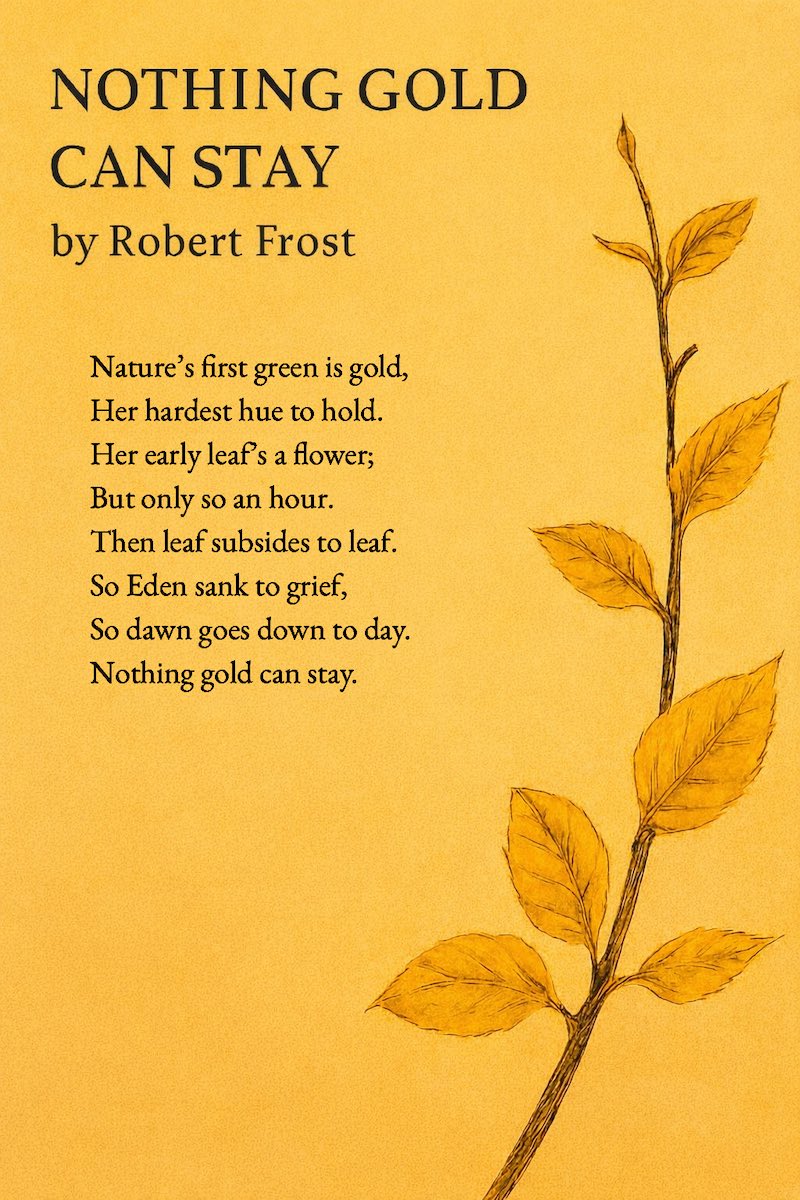
The Fleeting Hue: Robert Frost's "Nothing Gold Can Stay"
First published in 1923 in his Pulitzer Prize-winning collection New Hampshire, "Nothing Gold Can Stay" is one of the most celebrated works by Robert Frost. Widely regarded as the pastoral voice of American poetry, Frost was a master at using the quiet observations of the New England landscape to explore deep metaphysical truths. In this brief, tightly structured poem, he captures the bittersweet reality of impermanence, demonstrating how nature's most beautiful moments are also its most fleeting.
The Poem
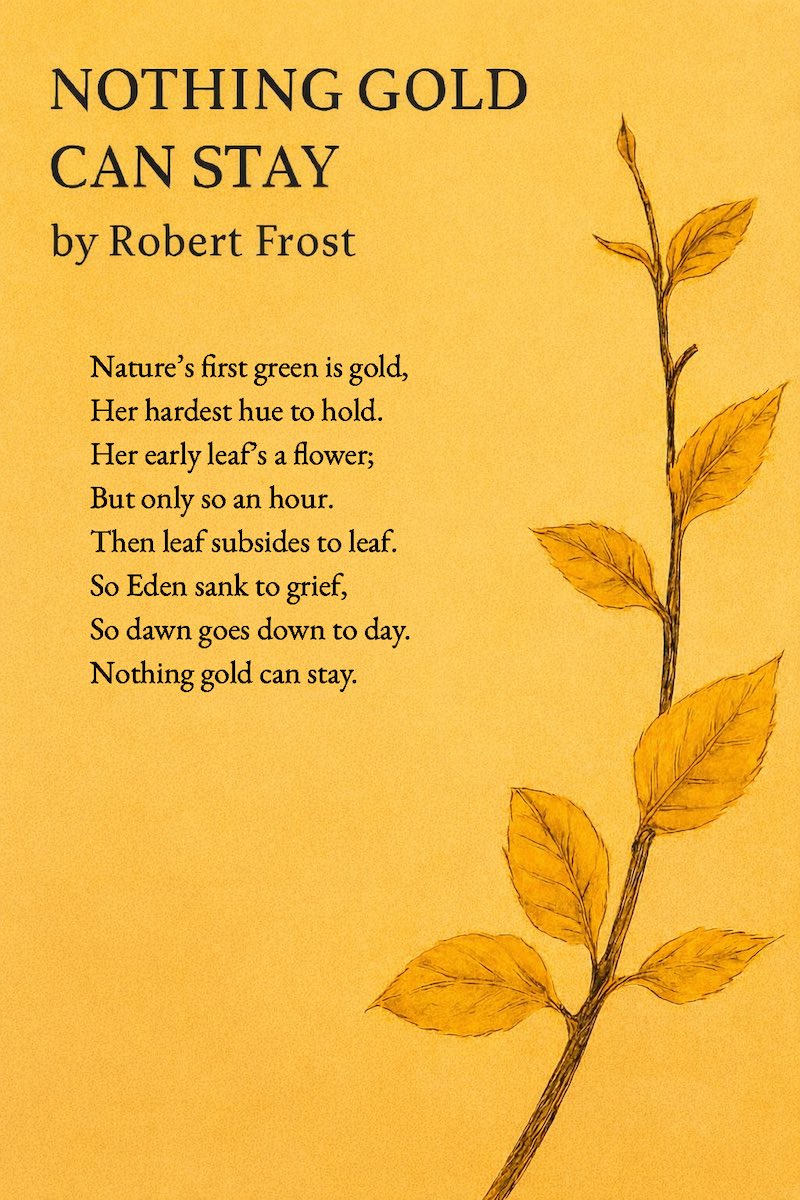
Nature’s first green is gold,
Her hardest hue to hold.
Her early leaf’s a flower;
But only so an hour.
Then leaf subsides to leaf.
So Eden sank to grief,
So dawn goes down to day.
Nothing gold can stay.
The Insight: The Fleeting Hue
At its heart, the poem captures a perfect snapshot of impermanence and the inevitability of change. By tracking the rapid transformation of a budding leaf, Frost suggests that beauty and perfection are inherently transient states, meant to be appreciated precisely because they cannot endure.
Frost utilizes a brilliant botanical paradox in the opening line, stating that "Nature’s first green is gold." He is referring to the delicate, golden-green hue of early spring buds—a color that vanishes almost as soon as it appears. By focusing on this fleeting transition, Frost elevates a common seasonal shift into a profound meditation on time, forcing the reader to confront how quickly the initial brilliance of any new beginning begins to fade. The economy of his language mirrors the brevity of the season itself, giving each rhyming couplet the weight of an ancient proverb.
The core philosophical "takeaway" broadens from a simple natural observation to a universal law in the final lines. By connecting the falling leaf to the fall of humanity ("So Eden sank to grief") and the passing of time ("So dawn goes down to day"), Frost reminds us that decay and transition are woven into the fabric of reality. To experience the "gold" in life—whether it is youth, love, or a perfect moment—means accepting the quiet sorrow that it must eventually subside.