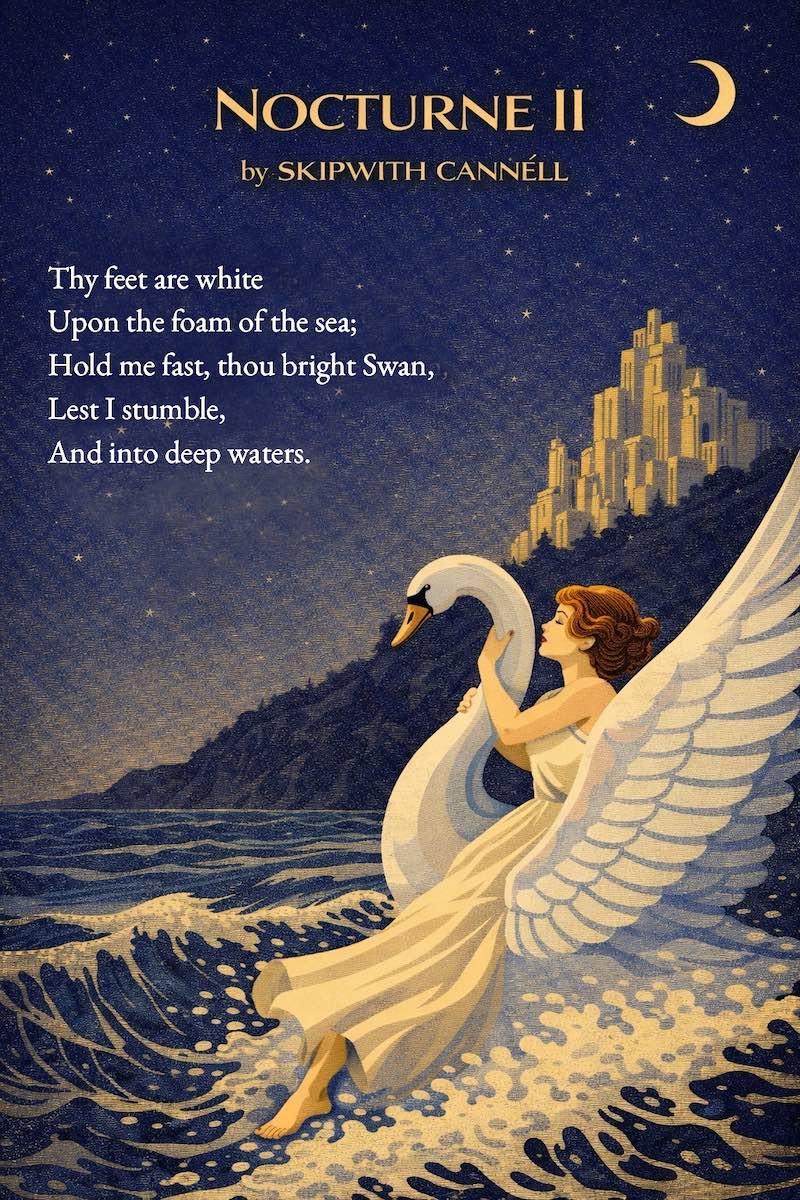
Holding Fast: Skipwith Cannéll's "Nocturne II"
A companion piece to the previous work, "Nocturne II" was also featured in the 1913 edition of Poetry magazine. Skipwith Cannéll continues to utilize the spare, evocative language of the Imagist movement to capture a moment of spiritual or emotional vulnerability. While the first "Nocturne" focused on the clarity of a torch's light, this second movement explores the precariousness of faith and the need for a stabilizing force amidst the "deep waters" of existence.
The Poem
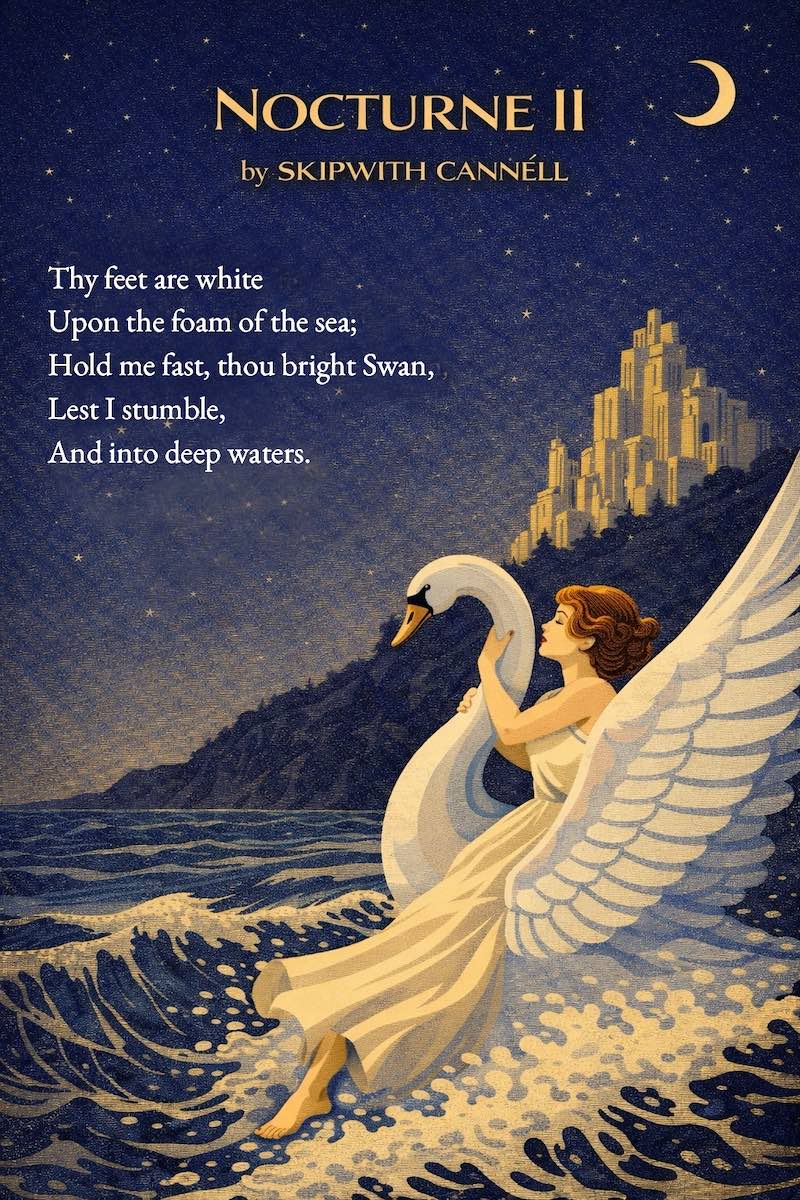
Thy feet are white
Upon the foam of the sea;
Hold me fast, thou bright Swan,
Lest I stumble,
And into deep waters.
The Insight: Holding Fast
The poem offers a delicate summary of human fragility and the search for anchorage. By personifying the "bright Swan" as a protector, Cannéll highlights the contrast between the purity and stability of the ideal and the stumbling, uncertain nature of the individual soul.
Cannéll utilizes the "foam of the sea" to represent a threshold—a place of constant motion, unpredictable shifts, and psychological danger. The "white feet" of the Swan suggest a transcendent being that remains perfectly untroubled by this chaos, moving across the churning waves with an effortless grace that the speaker lacks. By contrasting the fragile human impulse to "stumble" against the absolute purity of the "bright Swan," the poem captures the universal instinct to find a sacred anchor when the ground beneath us begins to give way.
The core philosophical "takeaway" is the admission of weakness. The speaker does not claim to be able to swim or navigate the "deep waters" alone; instead, they cry out to be held fast. It is a powerful reminder that there is a specific kind of strength found in recognizing our own limitations, showing that the act of reaching for something brighter and more enduring than ourselves is its own form of preservation.