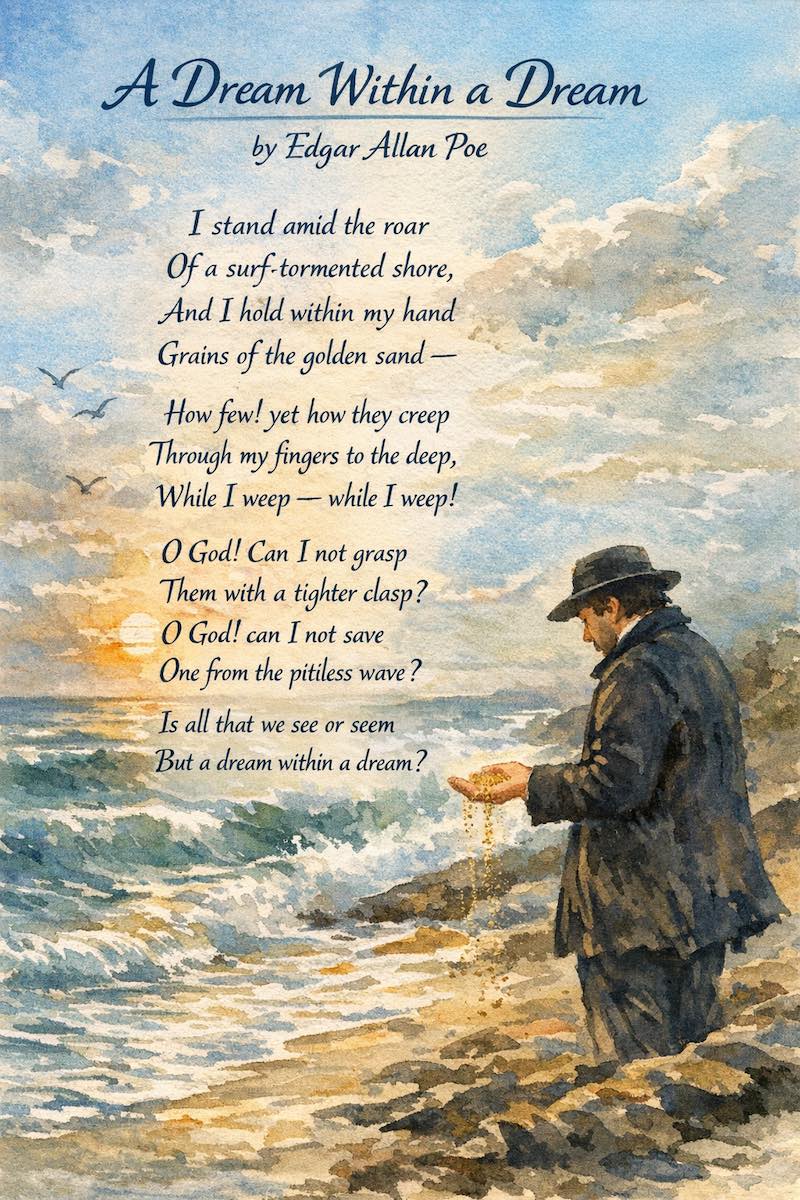
The Sand-Slipping Life: Edgar Allan Poe's "A Dream Within a Dream" (Excerpt)
First published in 1849, just months before his mysterious death, "A Dream Within a Dream" captures the haunting psychological intensity that Edgar Allan Poe is legendary for. As a master of Gothic literature and dark Romanticism, Poe used his verse to probe the fracture lines of the human mind, grief, and the terrifying nature of reality. By focusing exclusively on the poem's second movement, we find the speaker standing alone on the edge of a shifting shore, transforming a desperate physical struggle into a universal cry against the relentless slip of time.
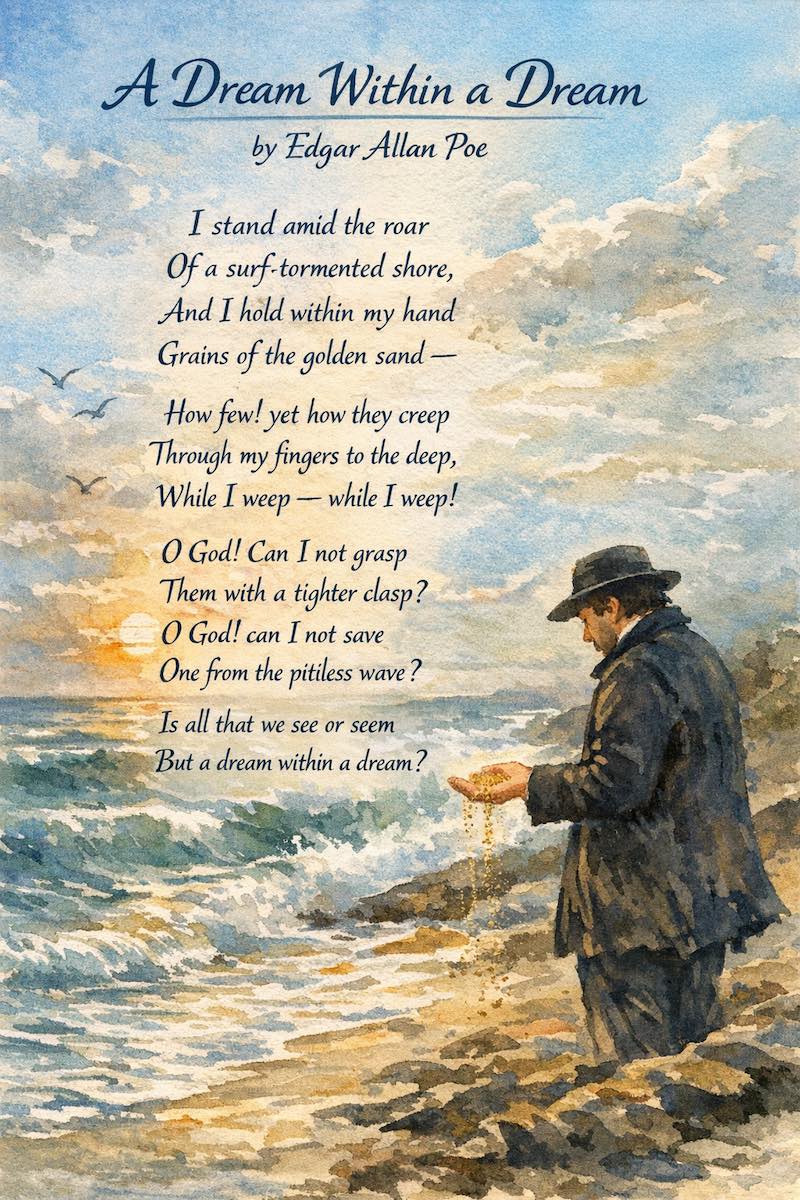
The Poem (Excerpt)
The Insight: The Sand-Slipping Life
This stanza offers a wrenching summary of existential helplessness and the illusion of control. By attempting to hold fast to grains of sand on a crashing coastline, Poe demonstrates the agonizing human struggle to retain a grip on love, memory, and reality itself as they are violently swept away by time.
Poe utilizes an intensely volatile natural landscape to establish the poem's urgent tone. The "surf-tormented shore" serves as a powerful metaphor for a mind under siege by grief and doubt, where the constant, overwhelming "roar" of the water drowns out all internal certainty. The economy of his short, rapid lines creates a claustrophobic rhythm, perfectly mimicking the rising panic of an individual who realizes that the very ground beneath him—and the treasures he tries to hold—are slipping away like water through clenched fists.
The core philosophical "takeaway" centers on the agonizing desperation of the stanza's concluding lines. The speaker moves rapidly from an intimate, physical struggle with the "creeping" sand to a cosmic confrontation, crying out to the divine for a tighter clasp. Poe leaves the reader suspended in the ultimate state of human vulnerability, ending not with a declaration, but with a pleading question. He suggests that if we cannot preserve even a single grain of what we love from the "pitiless wave" of time, then the boundary between waking life and a passing shadow ceases to exist entirely.