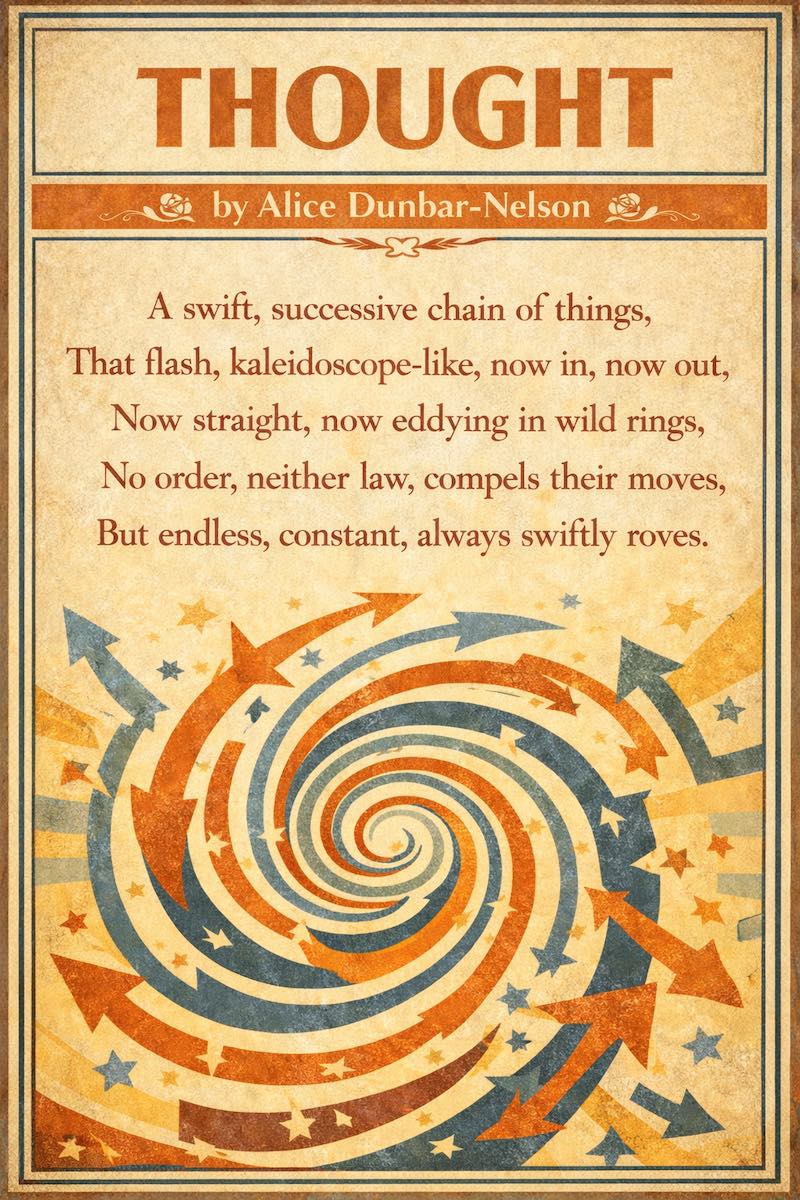
The Wandering Mind: Alice Dunbar-Nelson's "Thought"
First published in 1895 in her groundbreaking debut collection Violets and Other Tales, "Thought" is a dynamic five-line meditation on the inner workings of human consciousness by Alice Dunbar-Nelson (1875–1935). Dunbar-Nelson was just twenty years old when she published this collection, marking the start of a legendary career as a poet, journalist, educator, and political activist. What makes this piece even more intriguing historically is that Violets and Other Tales caught the attention of fellow poet Paul Laurence Dunbar; his admiration for her work sparked a famous literary correspondence that eventually led to their marriage. In this swift, five-line poem, she captures the chaotic, unbound energy of human imagination before modern psychology even had a standard language for it.
The Poem
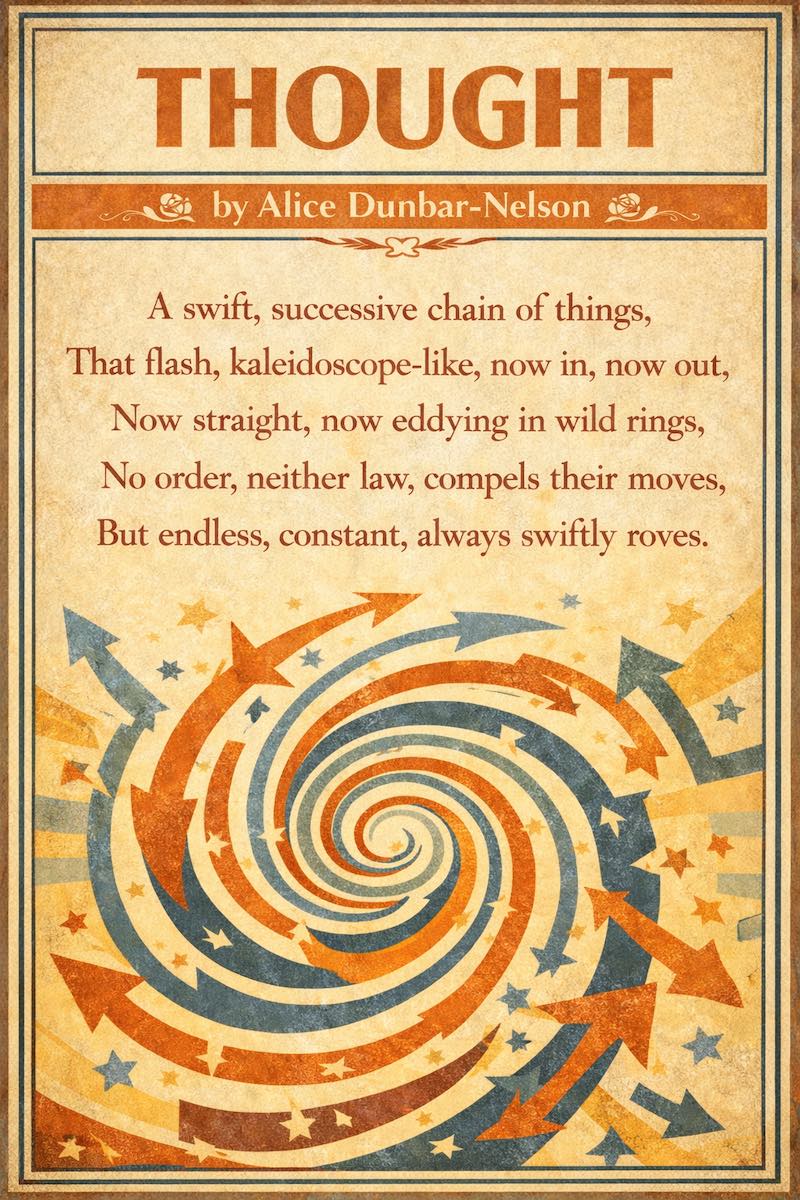
A swift, successive chain of things,
That flash, kaleidoscope-like, now in, now out,
Now straight, now eddying in wild rings,
No order, neither law, compels their moves,
But endless, constant, always swiftly roves.
The Insight: The Wandering Mind
This kinetic poem offers a vivid look at the unpredictable nature of human thought. By comparing the mind's inner ideas to a spinning kaleidoscope, Dunbar-Nelson shows how our imagination operates beyond rigid rules, constantly shifting and darting in unexpected directions.
Dunbar-Nelson opens with a striking sensory comparison, describing thoughts as a "swift, successive chain" that flashes "kaleidoscope-like." This image perfectly captures how ideas collide, shift, and transform in an instant, moving fluidly between direct focus ("now straight") and chaotic momentum ("eddying in wild rings").
In the final lines, the speaker emphasizes the ultimate freedom of the mind. Unbound by outside structure—where "no order, neither law, compels their moves"—our thoughts remain perpetually active, roving endlessly through memory, desire, and imagination without permission or restraint.