The Sand-Slipping Life: Edgar Allan Poe's "A Dream Within a Dream" (Excerpt)
First published in 1849, just months before his tragic and mysterious death, "A Dream Within a Dream" is a quintessential work by Edgar Allan Poe. As the master of American Gothic literature, Poe was renowned for exploring themes of loss and the breakdown of reality. While the full poem begins with a parting kiss, this focused exploration of the final stanza distills the work into its most potent philosophical image: a man standing at the edge of eternity, unable to hold back the tide of time.
The Poem (Excerpt)
The Insight: The Sand-Slipping Life
The stanza offers a haunting summary of the fundamental human experience of loss and the futility of control. By choosing a "surf-tormented shore" as the setting, Poe isolates his speaker at the precarious boundary where physical, stable land (the present moment) meets the unstable, indifferent force of the sea (eternity).
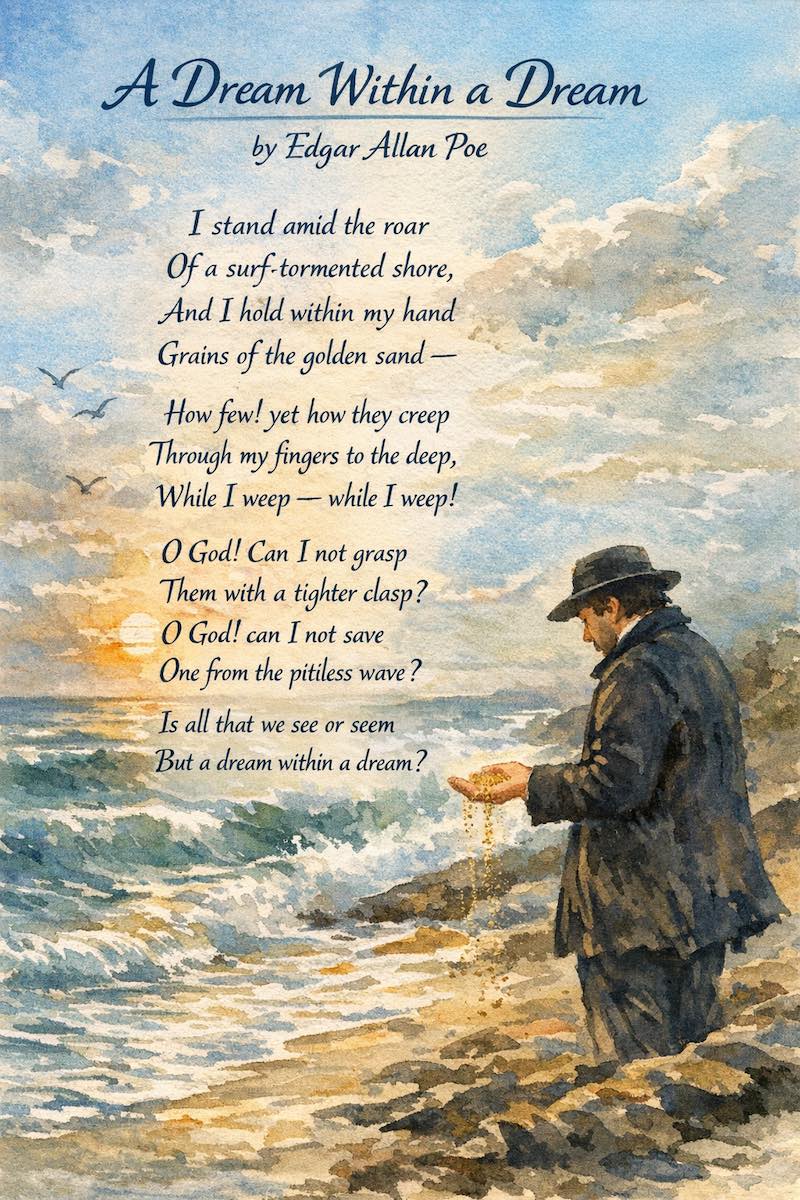
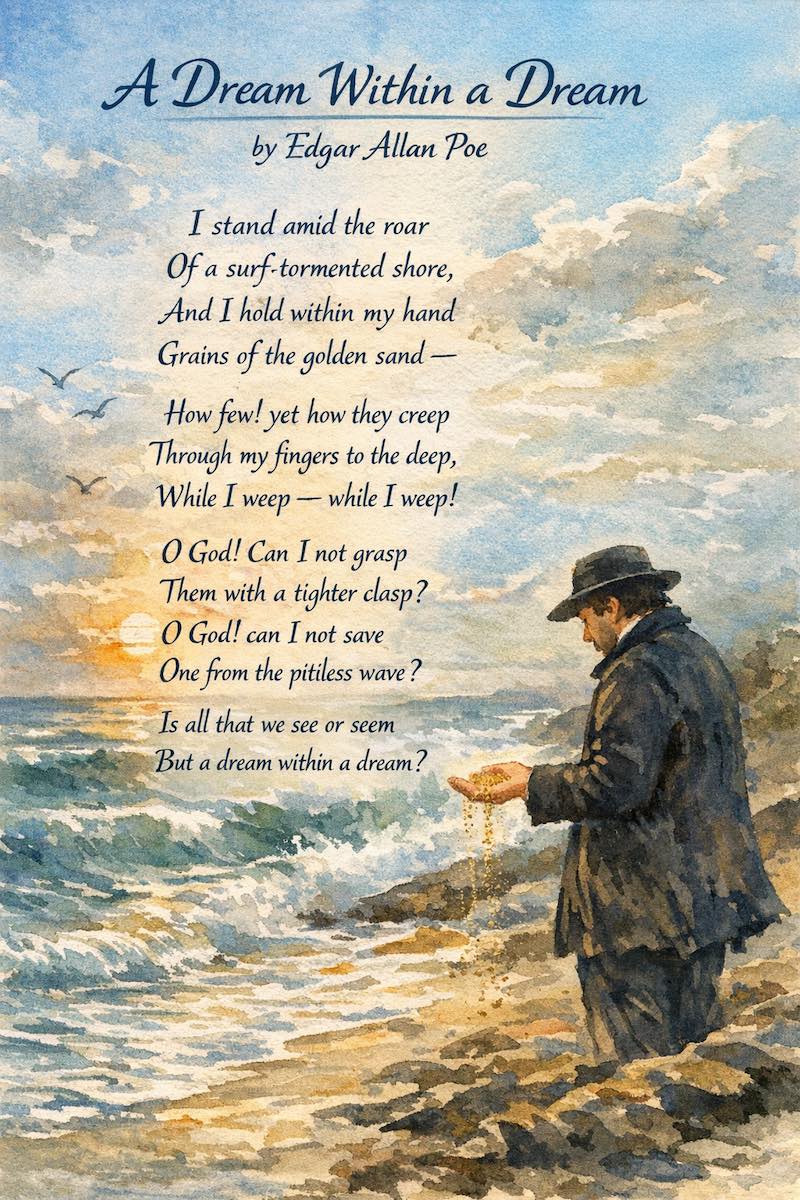
Poe centers this stanza around a devastatingly simple and powerful metaphor: the futile attempt to hold on to "grains of the golden sand." The illustration perfectly matches this tone, showing a lonely figure observing the grains vanish into the relentless waves. This image doesn't just represent losing specific memories; it symbolizes the inability to grasp any definitive reality as time sweeps everything away.
The power of the poem rests in its escalating desperation. The rhythm starts as a measured realization but quickly collapses into anguished, rhythmic questions. The core philosophical "takeaway" is that the more we fight to "grasp" and control the moments we have, the more visceral the pain of losing them becomes. Poe leaves us with the ultimate unresolved question: Is our entire perception of reality merely a projection—a dream—that we cannot hold?