Sorrowful Partings: Ezra Pound's "Taking Leave of a Friend"
First published in 1915 in his groundbreaking collection Cathay, "Taking Leave of a Friend" is a masterclass in imagery and restraint by Ezra Pound (1885–1972). What makes Cathay one of the most remarkable feats in modern literature is that Pound didn't actually speak or read Chinese when he produced these translations. Working from the posthumous notebooks of scholar Ernest Fenollosa, Pound adapted ancient Chinese works—this one originally written by the 8th-century Tang Dynasty poet Li Bai (also known as Li Po)—into vivid, modern English free verse. The legendary poet T.S. Eliot famously declared that through this collection, Pound became "the inventor of Chinese poetry for our time." In this poignant piece, Pound captures the quiet heartbreak of bidding farewell to a companion before a long journey.
The Poem
White river winding about them;
Here we must make separation
And go out through a thousand miles of dead grass.
Sunset like the parting of old acquaintances
Who bow over their clasped hands at a distance.
Our horses neigh to each other
as we are departing.
The Insight: Sorrowful Partings
This moving piece offers a delicate look at the heavy stillness of saying goodbye. By setting a human farewell against a vast, indifferent landscape, Pound shows how true friendship leaves a resonant echo even as paths diverge and miles stretch between two people.
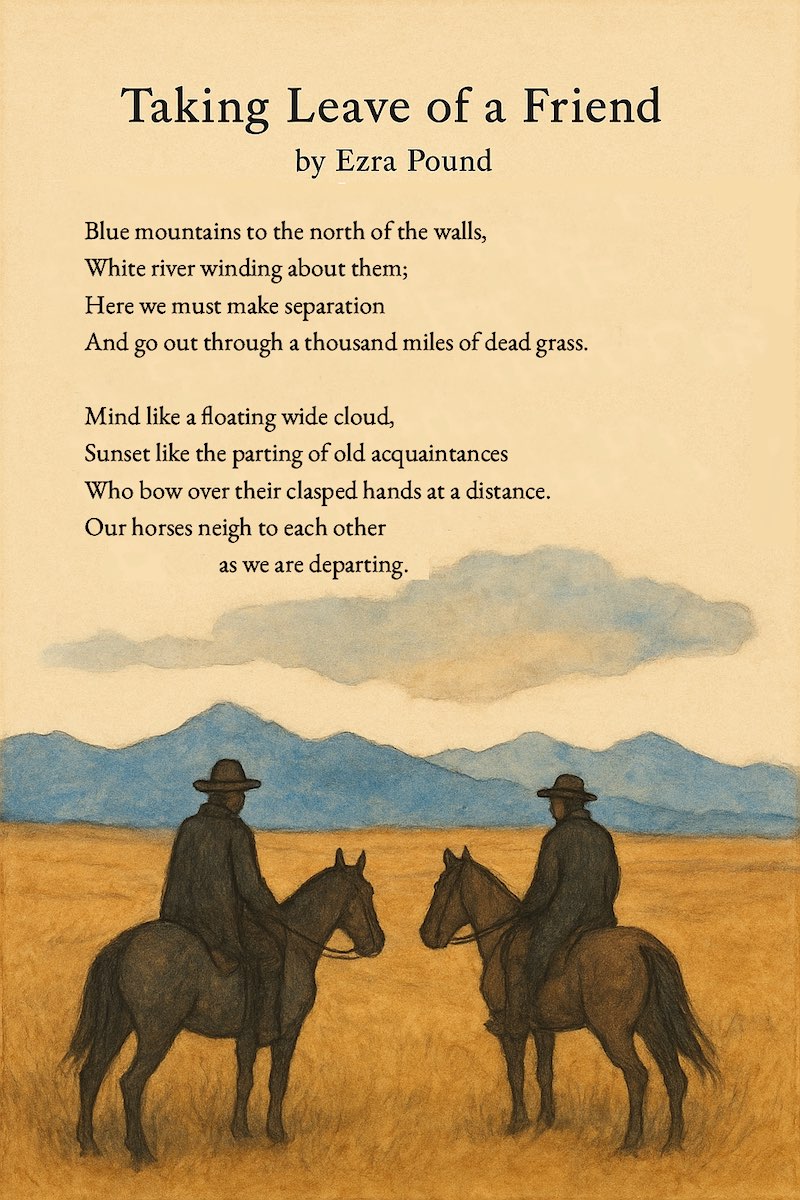
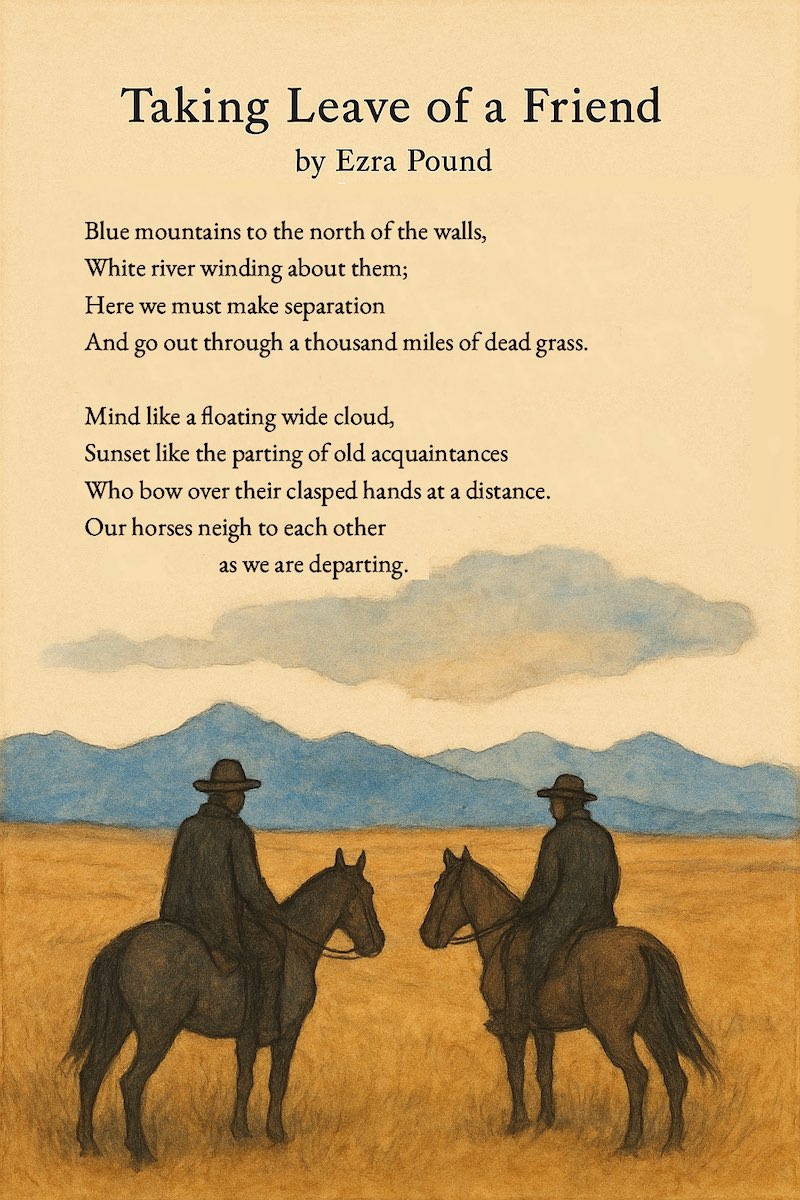
Pound opens with a sweeping sensory landscape, placing the reader between "blue mountains" and a "white river winding about them." The peaceful nature of the backdrop stands in stark, immediate contrast to the emotional reality of the moment: the unavoidable boundary where two travelers "must make separation" and venture across "a thousand miles of dead grass."
In the second stanza, the focus shifts to internal mood mirrored by the sky. Comparing a restless mind to a "floating wide cloud" and the setting sun to bowing acquaintances, Pound avoids dramatic grief in favor of quiet dignity. The final image of the horses neighing to one another as they part gives voice to the unsaid emotions of the men, grounding a painful farewell in a simple, haunting observation.