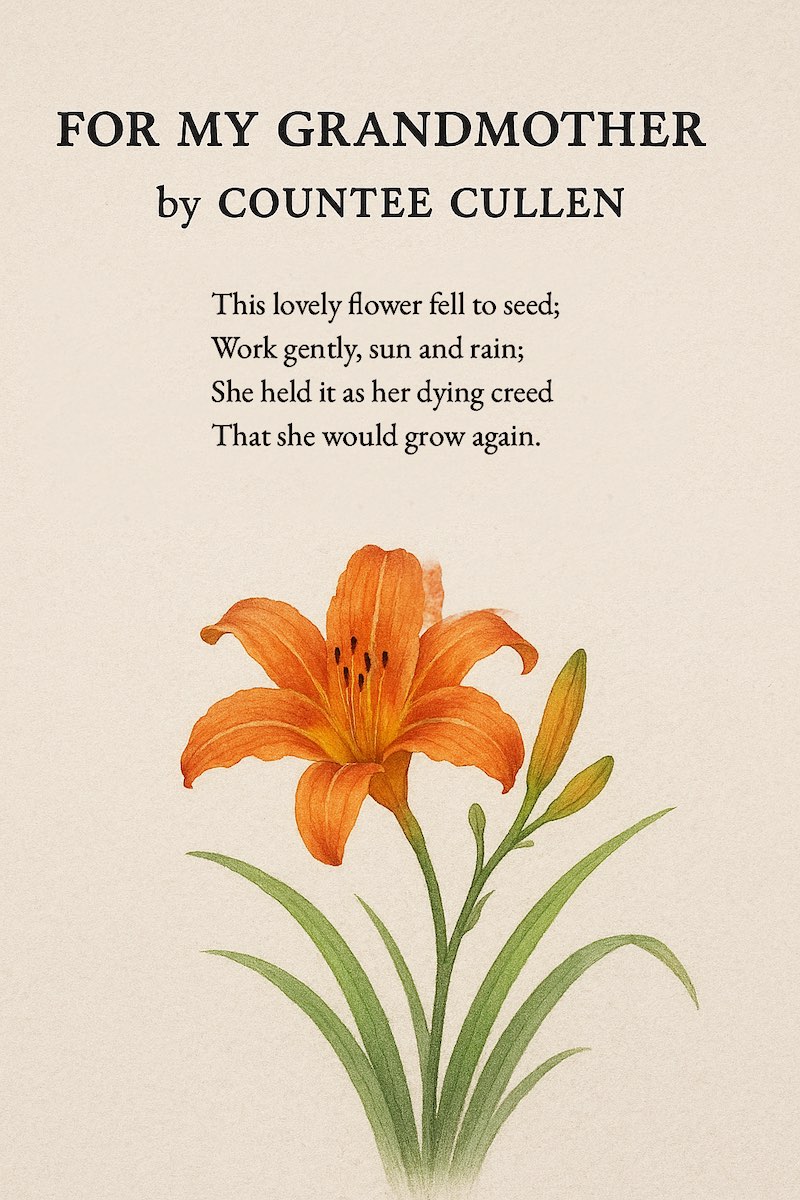
The Promise of Regrowth: Countee Cullen's "For My Grandmother"
First published in his landmark 1925 debut collection Color, "For My Grandmother" is a deeply moving epitaph by Countee Cullen, one of the most brilliant and traditionalist voices of the Harlem Renaissance. Unlike many of his contemporaries who experimented with free verse and jazz rhythms, Cullen favored classical structures, using them to explore complex themes of race, identity, and universal human emotion. In this brief, four-line elegy, he honors a life of quiet devotion, presenting a beautiful perspective on the relationship between lifelong faith and the journey into death.
The Poem
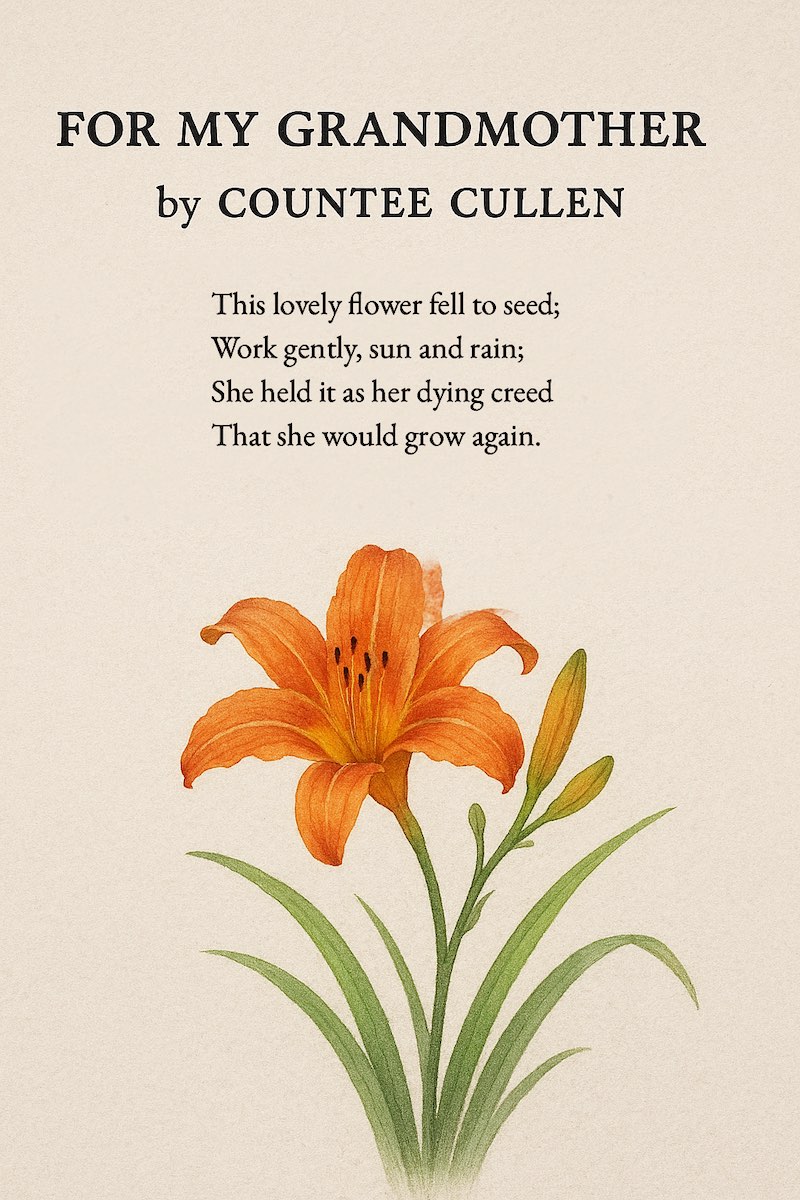
This lovely flower fell to seed;
Work gently, sun and rain;
She held it as her dying creed
That she would grow again.
The Insight: The Promise of Regrowth
The poem offers an exquisitely tender summary of enduring faith and the cycle of renewal. By framing death not as an end but as a natural transition from flower to seed, Cullen suggests that a life grounded in deep belief possesses an inherent peace that transcends the finality of the grave.
Cullen utilizes a profound botanical metaphor in the opening line, stating that "This lovely flower fell to seed." By choosing the word "seed" rather than decay, he reframes the physical passing of his grandmother as an act of planting rather than losing. The invocation to the elements—"Work gently sun and rain"—transforms the gravesite from a place of mourning into a quiet, nurturing garden, shifting the emotional weight of the piece from static grief to a sense of ongoing, natural care.
The core philosophical "takeaway" rests in the absolute simplicity of the final couplet. Cullen notes that she held it as a "simple creed / That she would rise again." There is no theological debate or complex doctrine here; instead, the poem celebrates the immense power of an uncomplicated, unwavering trust. It serves as a comforting reminder that the truest peace in the face of mortality often comes from a quiet, deeply rooted conviction that our journey does not end in the earth, but prepares us for a new beginning.