The Power of Perspective: T.E. Hulme's "Above the Dock"
First published in 1908, "Above the Dock" is a seminal work by T.E. Hulme, an English critic and poet who was a central figure in the development of Modernism. Hulme was the driving force behind the Imagist movement, which championed precision, clarity, and the use of the "hard, dry image" over the flowery sentimentality of the late Victorian era. This brief, four-line poem is a masterclass in how a single, well-placed metaphor can collapse the distance between the infinite cosmos and the mundane reality of human life.
The Poem
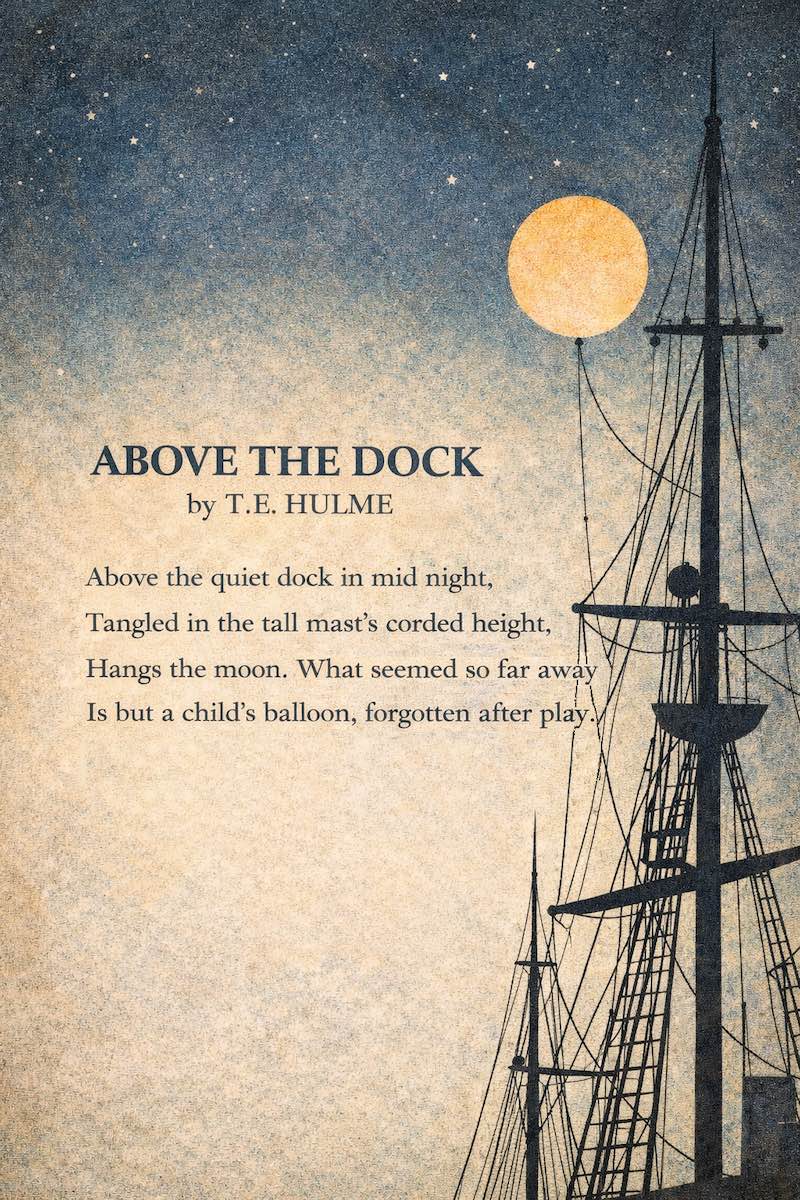
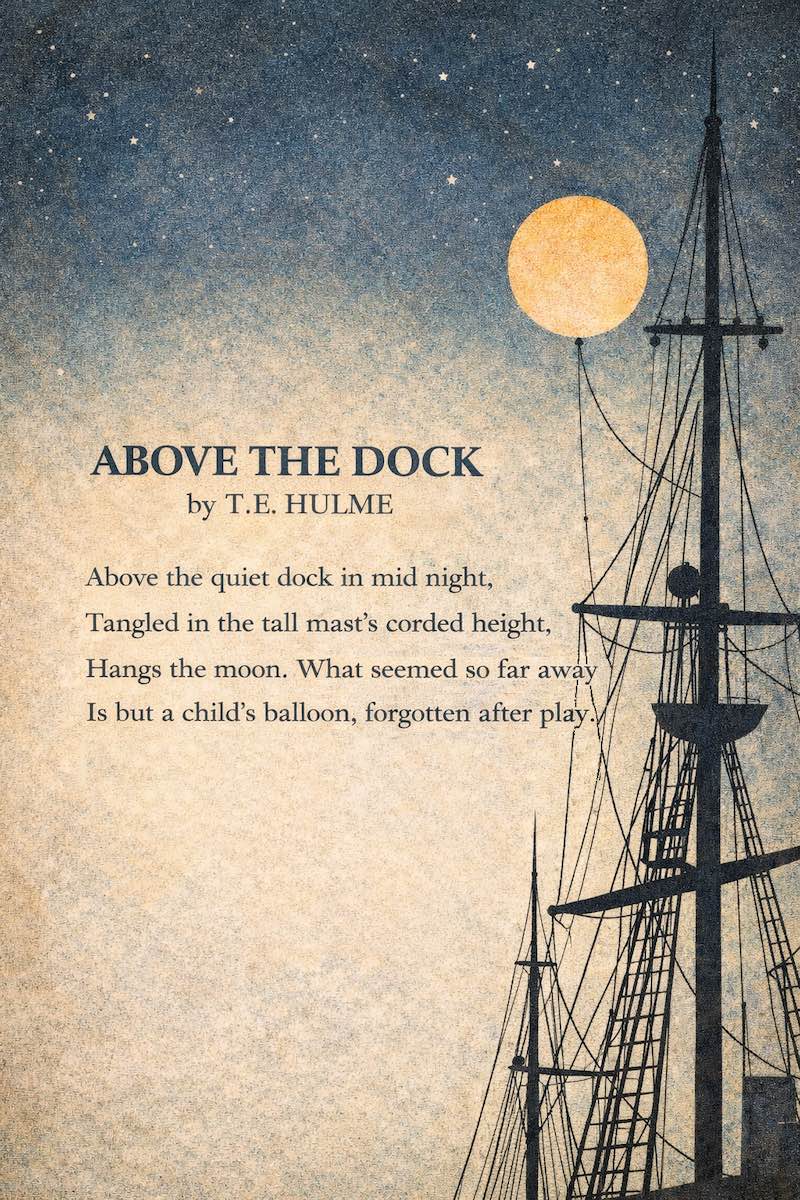
Above the quiet dock in mid night,
Tangled in the tall mast’s corded height,
Hangs the moon. What seemed so far away
Is but a child’s balloon, forgotten after play.
The Insight: The Power of Perspective
The poem offers a striking summary of how our physical environment and internal mindset can diminish the "overwhelming" nature of the world. By seeing the moon not as a celestial titan, but as a "child's balloon," Hulme suggests that even the most distant and cold aspects of existence can be understood through the lens of human experience and play.
Hulme utilizes a shift in scale that is both startling and comforting. The poem begins with a traditional, almost romantic setting—a quiet dock at midnight—but quickly subverts expectations. The word "tangled" is key; it implies that the moon has been caught or ensnared by the physical structures of man (the mast’s corded height), stripping it of its untouchable divinity.
The transition in the third and fourth lines is the heart of the Imagist mission. By comparing the moon to a forgotten balloon, Hulme removes the "metaphysical weight" of the night sky. The moon is no longer a goddess or a mystery; it is a familiar object from childhood. This perspective doesn't diminish the beauty of the scene but rather makes it accessible, suggesting that the vast mysteries of the universe are often just a matter of how—and from where—we choose to look.