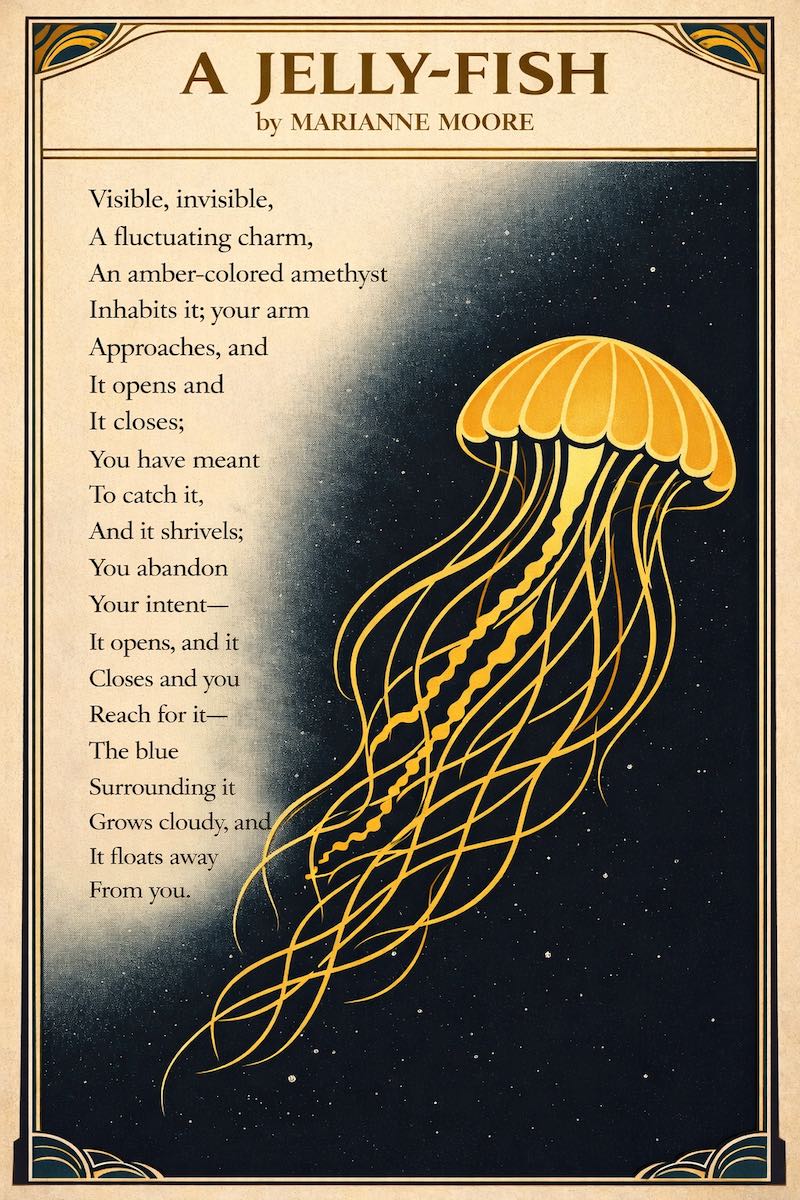
A Fluctuating Charm: Marianne Moore's "A Jelly-Fish"
First published in 1909 in the Bryn Mawr literary magazine Tipyn o’Bob, "A Jelly-Fish" is a striking early example of the signature precision that defined Marianne Moore. As a towering figure of American Modernism, Moore (1887–1972) was celebrated for her intricate verse and her keen, almost scientific eye for the natural world. In this brilliantly condensed work, she explores the immediate tension that arises when we try to force a fluid world into static comprehension.
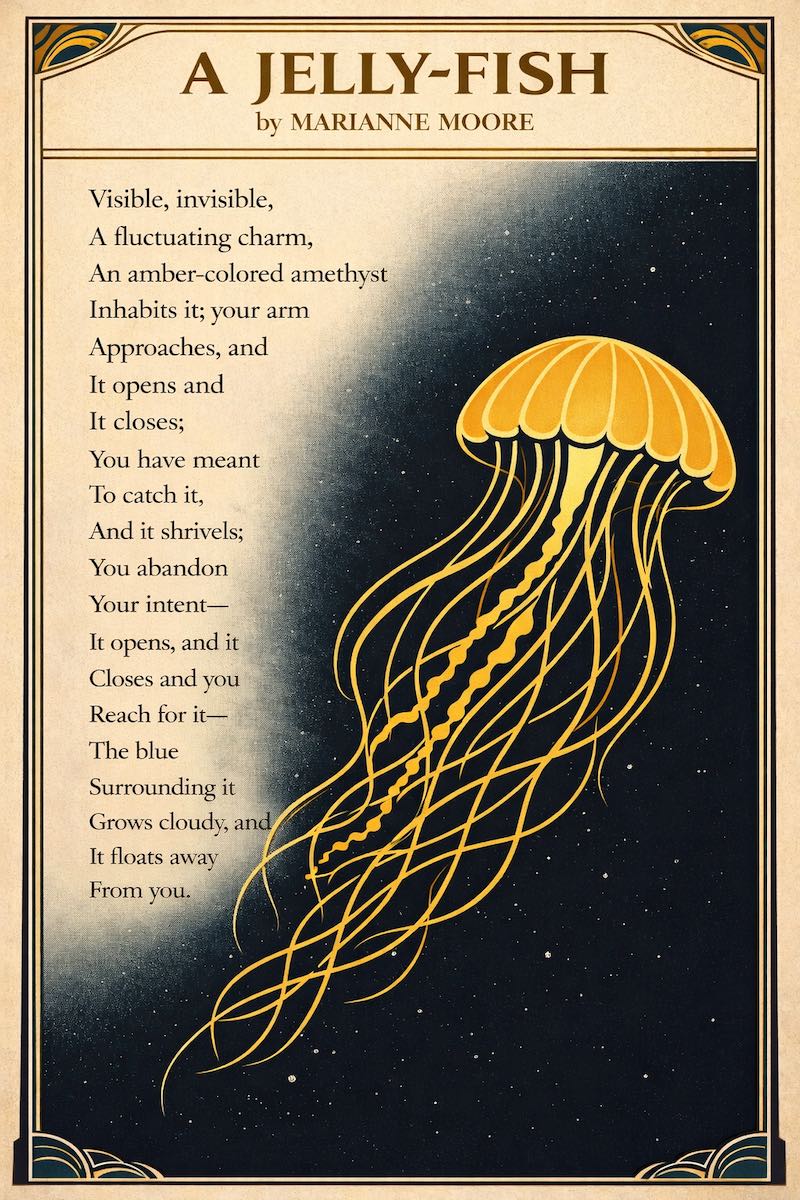
The Poem
Visible, invisible,
A fluctuating charm,
An amber-colored amethyst
Inhabits it; your arm
Approaches, and
It opens and
It closes;
You have meant
To catch it,
And it shrivels;
You abandon
Your intent—
It opens, and it
Closes and you
Reach for it—
The blue
Surrounding it
Grows cloudy, and
It floats away
From you.
The Insight: A Fluctuating Charm
This short piece gives us a beautiful look at the futility of forced possession. By tracing the push-and-pull dynamic between the curious observer and the defensive sea creature, Moore suggests that certain beauties can only be appreciated when we let go of our urge to dominate or capture them.
Moore uses a clever sensory paradox in the opening lines, describing the creature as both "Visible, invisible" and a "fluctuating charm." This fluid structure perfectly mimics the movement of the jellyfish itself, existing in a constant state of transition. By using short, jagged line breaks that cut right through simple phrases, she physically disrupts our reading momentum to mirror the shifting tides and elusive nature of her subject.
The core philosophical "takeaway" anchors itself in the cyclical frustration of human intent. The moment we reach out to "catch it," the charm immediately shrivels and completely shuts down its beauty in response to aggression. The real message here is that our insistence on grasping and holding onto things ultimately clouds the clarity around us, driving away the very magic we want to capture.