The Architecture of the Soul: George Herbert’s "The World" (Excerpt)
Written by the master of metaphysical devotion, George Herbert, "The World" was first published posthumously in his 1633 collection, The Temple. As a priest and poet, Herbert used architectural metaphors to explore the fragile relationship between divine creation and human vanity. This excerpt focuses on the foundational tension between the lasting work of Love and the fleeting "fancies" of Fortune.
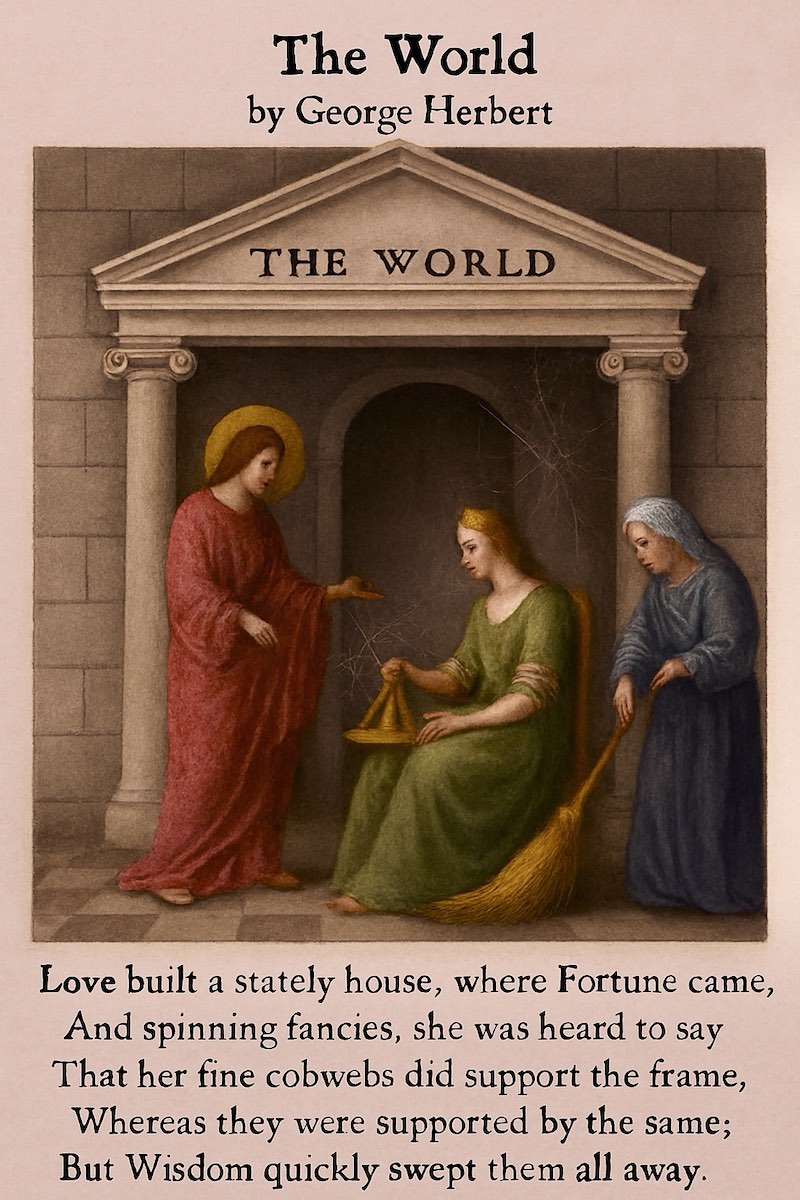
The Poem (Excerpt)
Love built a stately house, where Fortune came,
And spinning fancies, she was heard to say
That her fine cobwebs did support the frame,
Whereas they were supported by the same;
But Wisdom quickly swept them all away.
The Insight: Divine Foundation vs. Human Pretense
The poem offers a sharp reminder that while we often credit our luck or "Fortune" for the stability of our lives, the true structure is built on a much deeper, divine foundation. Our attempts to take credit for our successes are often as flimsy as cobwebs.
Herbert employs a powerful personification of Love, Fortune, and Wisdom to dramatize the spiritual state of man. By describing the "stately house" as being built by Love, he establishes that existence is a gift, not an achievement. The irony lies in Fortune’s claim that her "fine cobwebs" support the massive frame of the house, when in reality, the house is what allows the cobwebs to exist at all.
The imagery of the cobweb serves as a perfect metaphor for the delicate, sticky, yet ultimately insubstantial nature of worldly vanity. When Wisdom enters the scene, the resolution is swift; truth does not require a complex argument, merely a clean sweep of the illusions we spin around ourselves.