Lessons in Lowliness: Jane Taylor’s "The Violet"
Best known for penning the lyrics to "Twinkle, Twinkle, Little Star," Jane Taylor was a prolific English poet and novelist whose work often focused on moral and spiritual themes for children. "The Violet," published in 1806 within the collection Rhymes for the Nursery, is one of her most enduring pieces. It uses the simple, unassuming beauty of a common flower to deliver a timeless message about the value of modesty.
The Poem
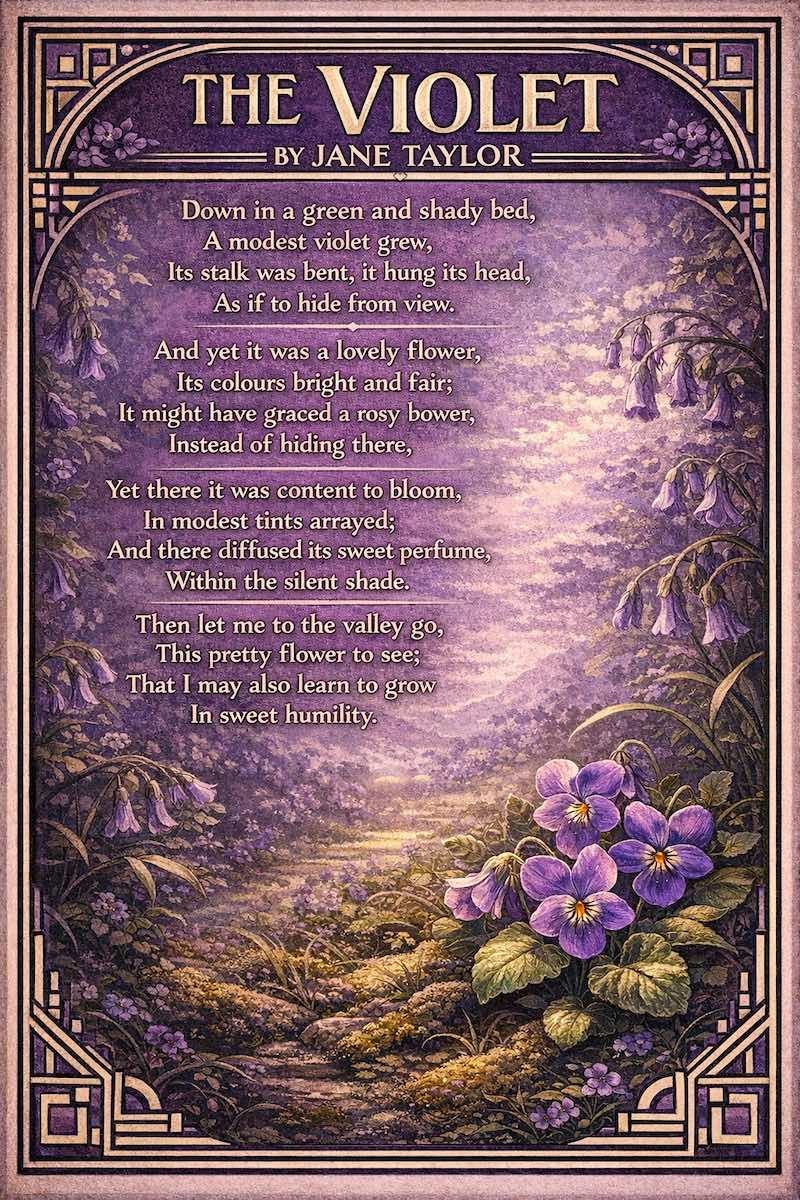
Down in a green and shady bed,
A modest violet grew,
Its stalk was bent, it hung its head,
As if to hide from view.
And yet it was a lovely flower,
Its colours bright and fair;
Yet there it was content to bloom,
In sweet humility.
The Insight: The Virtue of Humility
The core "takeaway" of "The Violet" is that true worth does not require a stage. Taylor highlights that the violet is "content to bloom" and share its fragrance even in the "silent shade," suggesting that character and beauty are most virtuous when they exist without the need for external validation or a "rosy bower."
Taylor employs a classic ABAB rhyme scheme that gives the poem a song-like, accessible quality, fitting for its nursery origin. However, the imagery is quite sophisticated; by personifying the violet as having a "bent stalk" and "hanging its head," she directly links the flower's physical posture to the human trait of humility.
The contrast between the "shady bed" and the "rosy bower" serves as a metaphor for social standing. While the violet is beautiful enough to belong among the most elite flowers, it chooses the valley. The final stanza shifts from observation to application, as the speaker expresses a desire to "learn to grow" like the flower, turning a simple nature study into a profound moral aspiration.