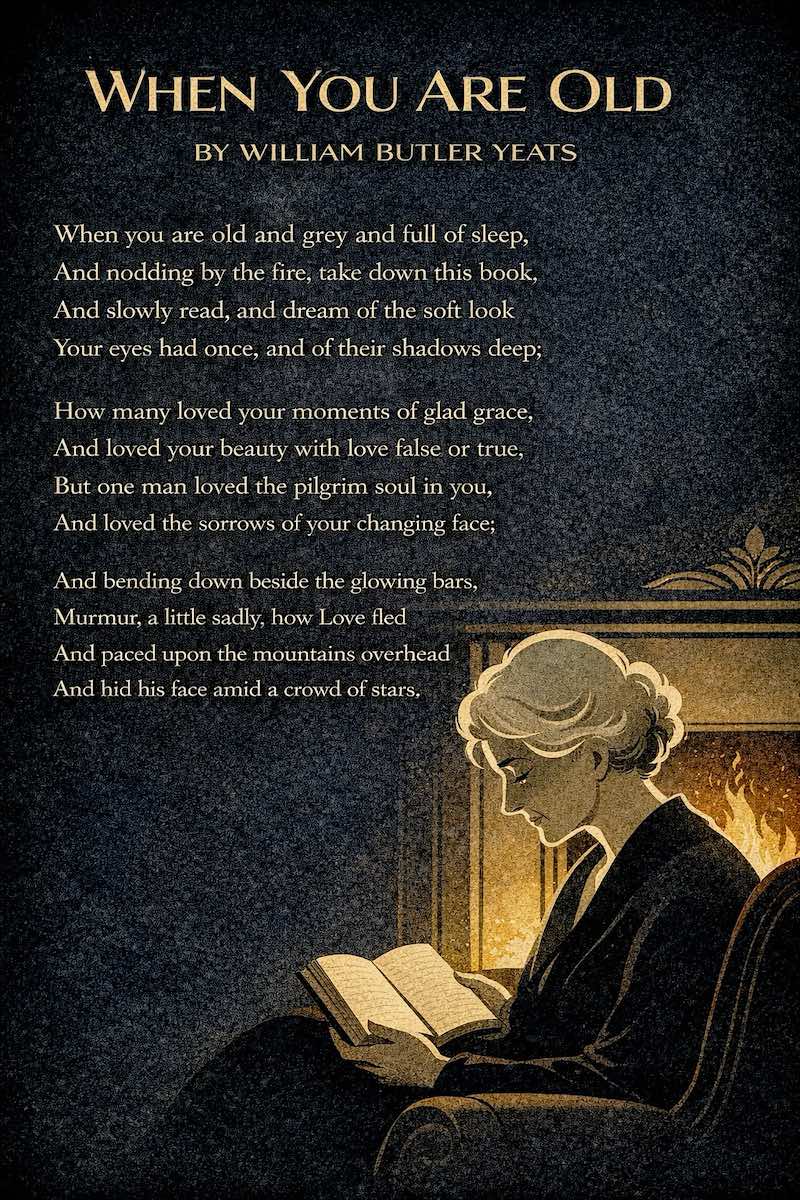
The Pilgrim Soul: William Butler Yeats's "When You Are Old"
Published in his 1893 collection The Rose, "When You Are Old" is one of the most poignant works of William Butler Yeats, a titan of 20th-century Irish literature. Written during his intense and often unrequited pursuit of the Irish revolutionary Maud Gonne, the poem serves as a haunting meditation on time, beauty, and the rarity of true devotion. Yeats blends a gentle, rhythmic cadence with a melancholic warning, inviting the reader to consider what remains when the "moments of glad grace" have long since faded.
The Poem
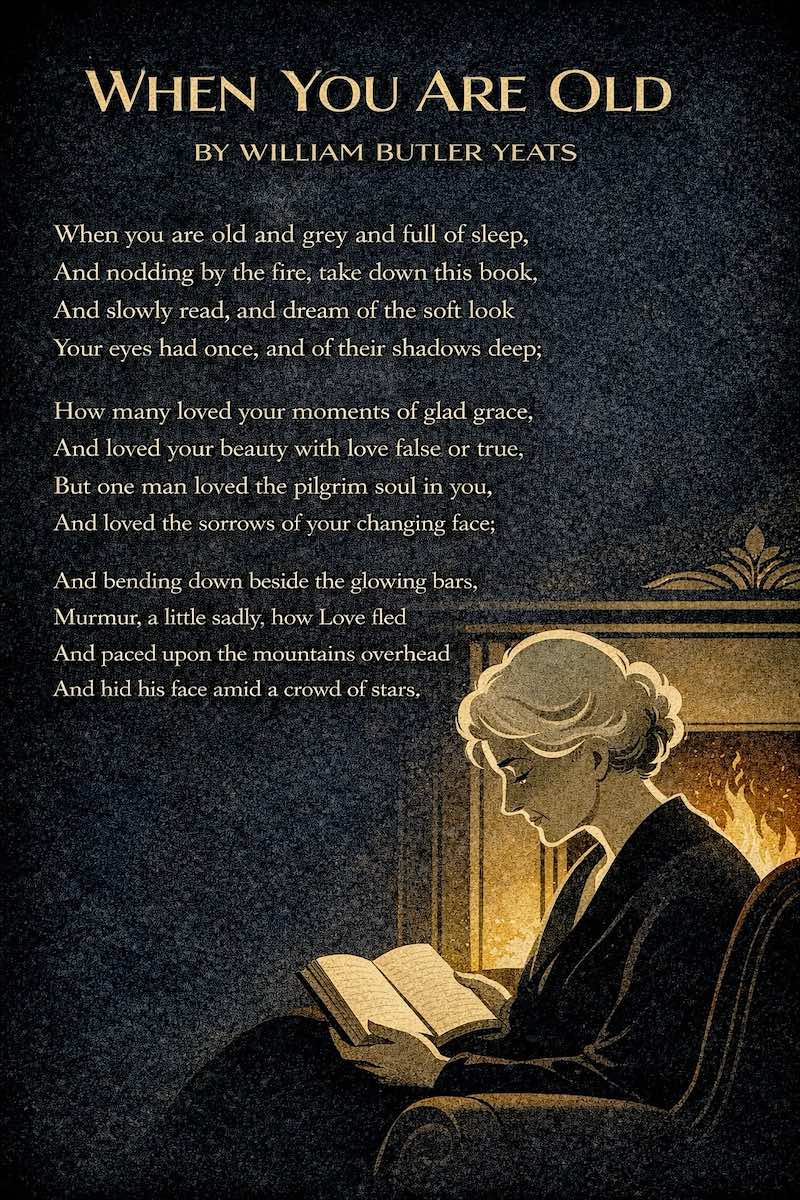
When you are old and grey and full of sleep,
And nodding by the fire, take down this book,
And slowly read, and dream of the soft look
Your eyes had once, and of their shadows deep;
How many loved your moments of glad grace,
And loved your beauty with love false or true,
But one man loved the pilgrim soul in you,
And loved the sorrows of your changing face;
And bending down beside the glowing bars,
Murmur, a little sadly, how Love fled
And paced upon the mountains overhead
And hid his face amid a crowd of stars.
The Insight: The Pilgrim Soul
The poem offers a profound summary of the difference between superficial attraction and the love of a "pilgrim soul". By contrasting those who loved the subject's "glad grace" with the one who loved her "changing face," Yeats suggests that true love is an appreciation of an individual's spiritual journey and internal character, rather than their outward youth.
Yeats employs a future-tense narrative to create a sense of inevitable reflection. The imagery of the "glowing bars" of a fire and the "soft look" of the past creates a domestic, intimate setting for a grand philosophical realization. The personification of Love at the end of the poem—fleeing to the mountains and hiding among the stars—serves as a powerful metaphor for missed opportunity and the transcendent, almost celestial nature of the affection that was offered.
The core philosophical "takeaway" is that while physical beauty is fleeting, the soul remains a constant. Yeats encourages us to value the "sorrows" and the changes that life brings, as they are the true marks of a life lived and a soul worth loving.