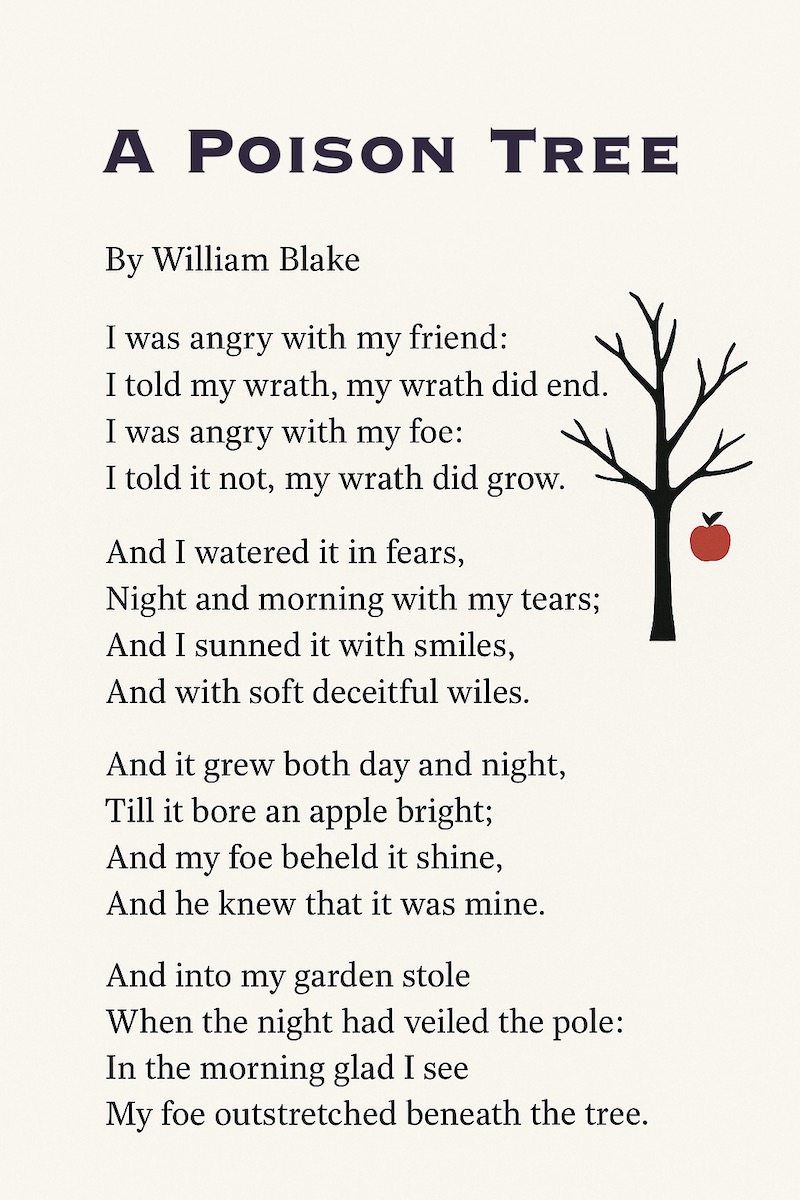
The Harvest of Wrath: William Blake’s "A Poison Tree"
William Blake, a visionary artist and poet of the Romantic era, often used his work to explore the "two contrary states of the human soul." His poem "A Poison Tree," first published in 1794 in the landmark collection Songs of Experience, serves as a dark warning about the dangers of suppressed emotion. While his Songs of Innocence focused on the purity of the spirit, this piece delves into the murky depths of human nature—specifically, how unspoken anger can grow into something lethal.
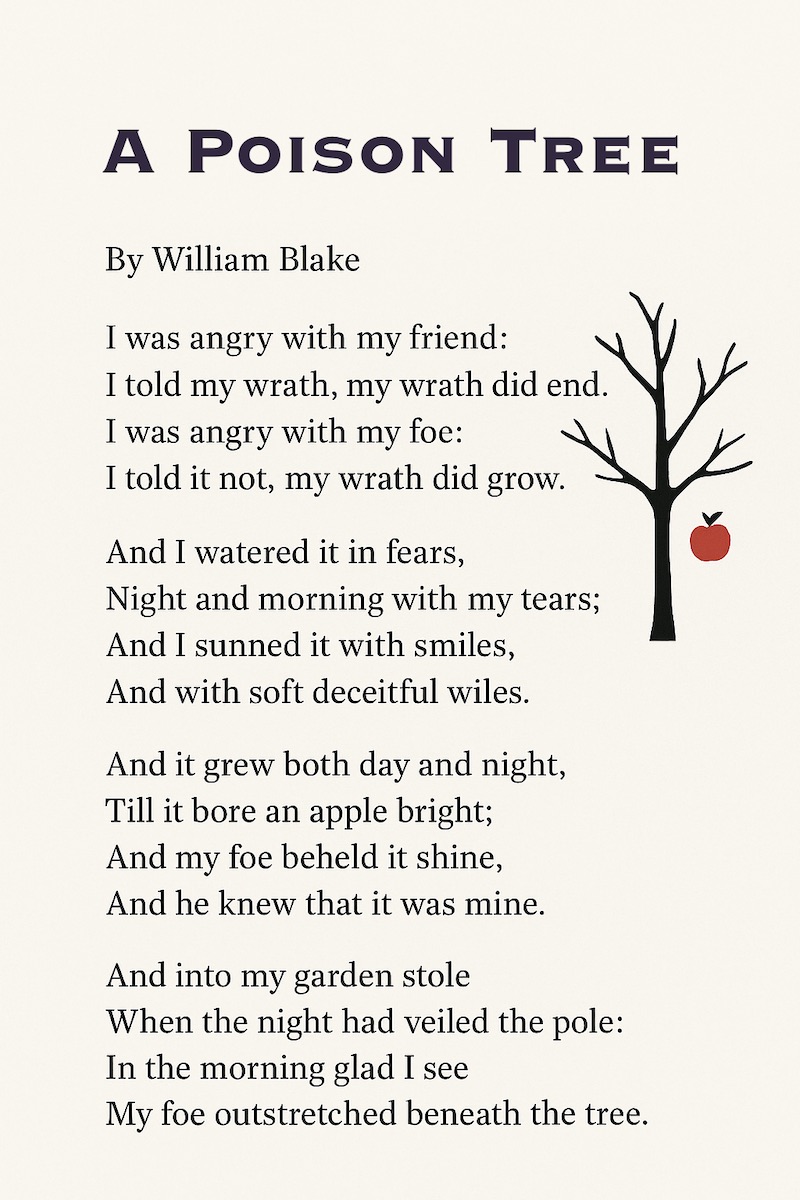
The Poem
I was angry with my friend:
I told my wrath, my wrath did end.
I was angry with my foe:
I told it not, my wrath did grow.
And I watered it in fears,
Night and morning with my tears;
And I sunned it with smiles,
And with soft deceitful wiles.
And it grew both day and night,
And into my garden stole
The Insight: The Toxicity of Silence
The central "insight" of this poem is the destructive power of repressed anger. Blake presents a simple contrast: when we express our feelings ("I told my wrath"), the conflict resolves. However, when we hide our resentment behind "smiles" and "deceitful wiles," that anger becomes a living thing—a metaphorical tree that produces a poisonous fruit. The poem suggests that silence is not a sign of peace, but often the very soil in which revenge takes root.
Blake utilizes a steady, driving AABB rhyme scheme in quatrains that gives the poem a nursery-rhyme quality. This simplicity stands in chilling contrast to the poem's violent conclusion. The speaker describes nurturing his anger like a garden, "watering" it with fears and "sunning" it with false smiles. This imagery shifts the responsibility of the "poison" from a natural accident to a deliberate, calculated act of cultivation.
The final two stanzas move from the internal growth of anger to its external consequence. The "apple bright" serves as a classic allusion to the forbidden fruit of the Garden of Eden, representing a temptation that leads to a fall. The ending is notably dark; the speaker is "glad" to see his foe defeated. By concluding the poem on this note of grim satisfaction, Blake forces the reader to confront the "Experience" of the fallen human state, where wrath is not just a feeling, but a weapon.