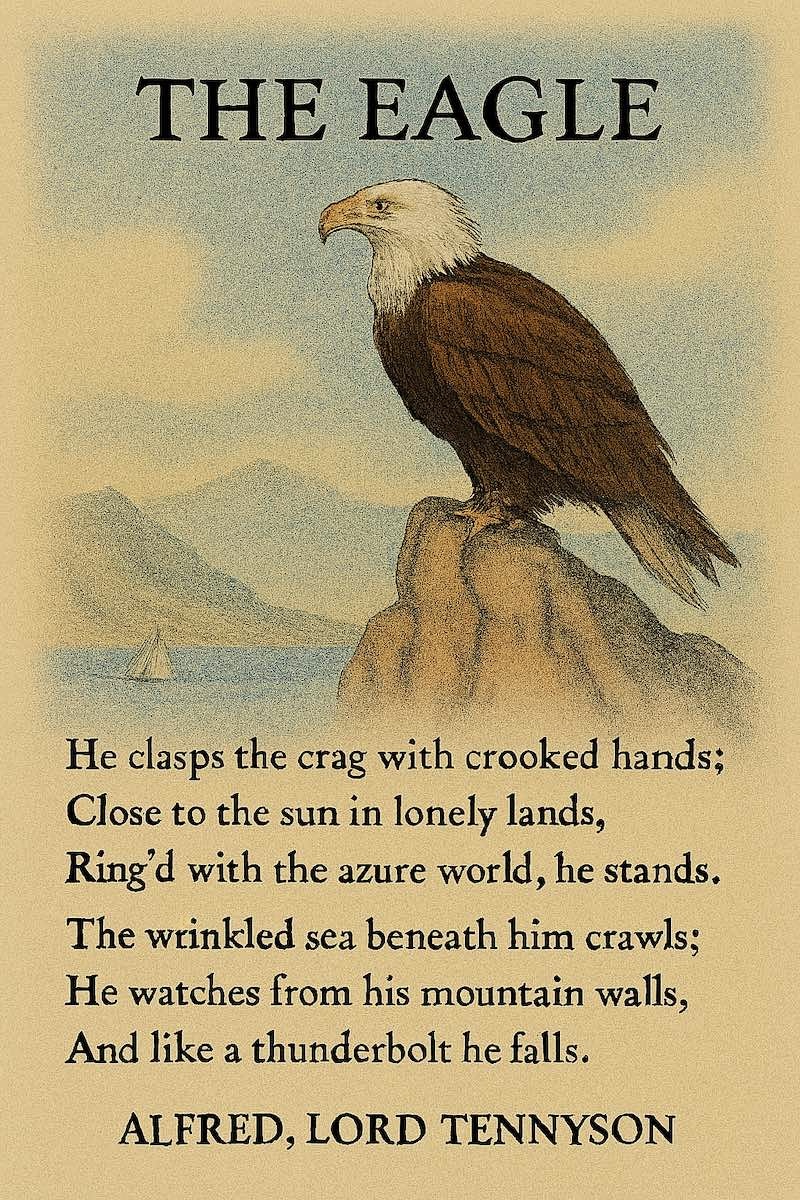
The Majesty of Power: Tennyson’s Six-Line Masterpiece, "The Eagle"
Alfred, Lord Tennyson, one of the Victorian era's most famous poets, achieved a remarkable combination of sound and meaning in his six-line poem, "The Eagle: A Fragment." First published in 1851, this poem, inspired by Tennyson's travels in the Pyrenees, is a masterpiece of precision and imagery. It captures a fleeting moment of pure, majestic power, making it a perfect example of concise verse.
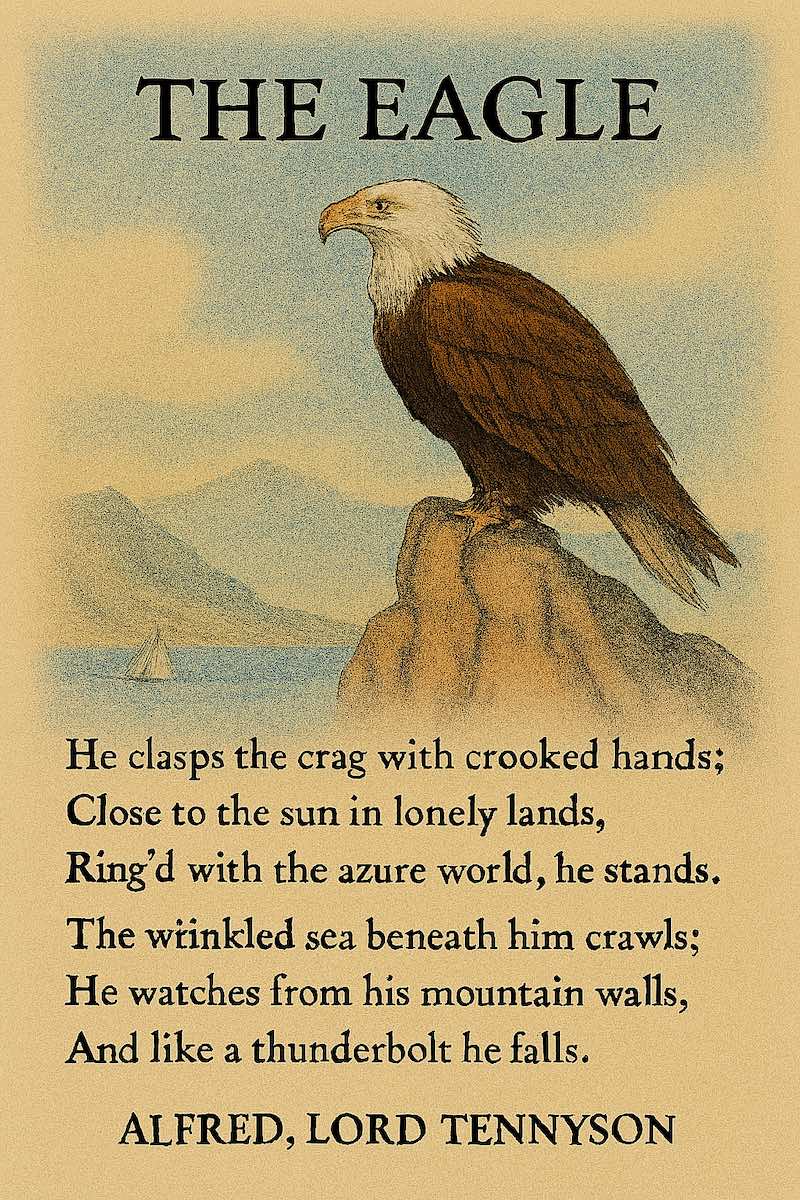
The Poem
He clasps the crag with crooked hands;
Close to the sun in lonely lands,
The wrinkled sea beneath him crawls;
The Insight: The P
The poem is a perfect lyric fragment, structured as two three-line stanzas (triplets) with a simple, memorable rhyme scheme (AAA BBB). Its power is in the vivid imagery and the dramatic shift in perspective.
The first stanza establishes the eagle's commanding, solitary presence. The use of personification in the line "He clasps the crag with crooked hands" gives the bird a fierce, almost human-like grip and personality, emphasizing its dominion. By standing "Close to the sun in lonely lands," the eagle is elevated beyond the ordinary, near the celestial.
The second stanza shifts the focus downward. From the eagle's lofty height, the vast ocean is minimized, described as "wrinkled" and seen to "crawl" beneath him. This personification brilliantly highlights the bird's massive scale and the insignificance of the world below. The final line, "And like a thunderbolt he falls," uses a powerful simile to describe the bird's swift, sudden descent, perfectly concluding the action and cementing the eagle as a symbol of swift, decisive power.