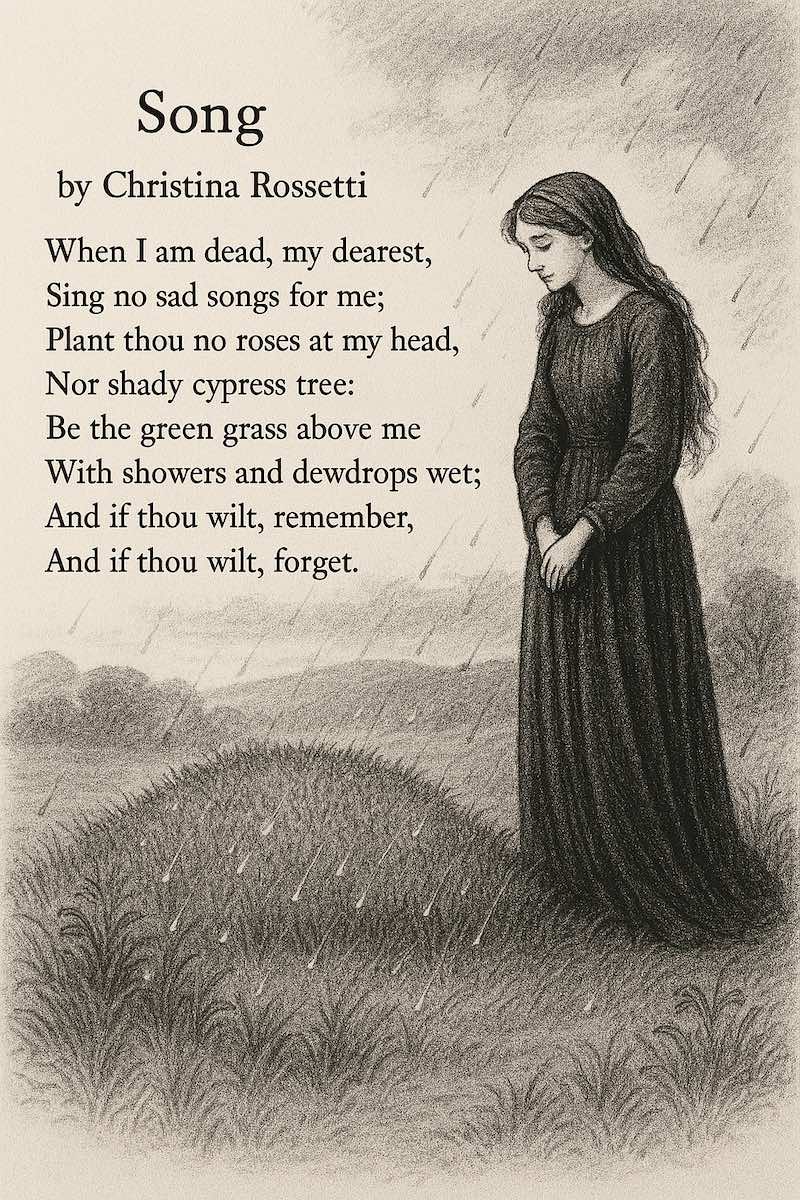
A Quiet Acceptance: Christina Rossetti’s "Song" and the Art of Letting Go
Christina Rossetti, a titan of the Victorian era and a central figure in the Pre-Raphaelite movement, often explored the delicate intersections of love, faith, and mortality. Her poem "Song" (frequently known by its first line, "When I am dead, my dearest"), first published in 1862 in her landmark collection Goblin Market and Other Poems, is a masterclass in emotional restraint. In this brief opening stanza, Rossetti challenges the Victorian tradition of elaborate mourning, offering instead a startlingly peaceful vision of remembrance.
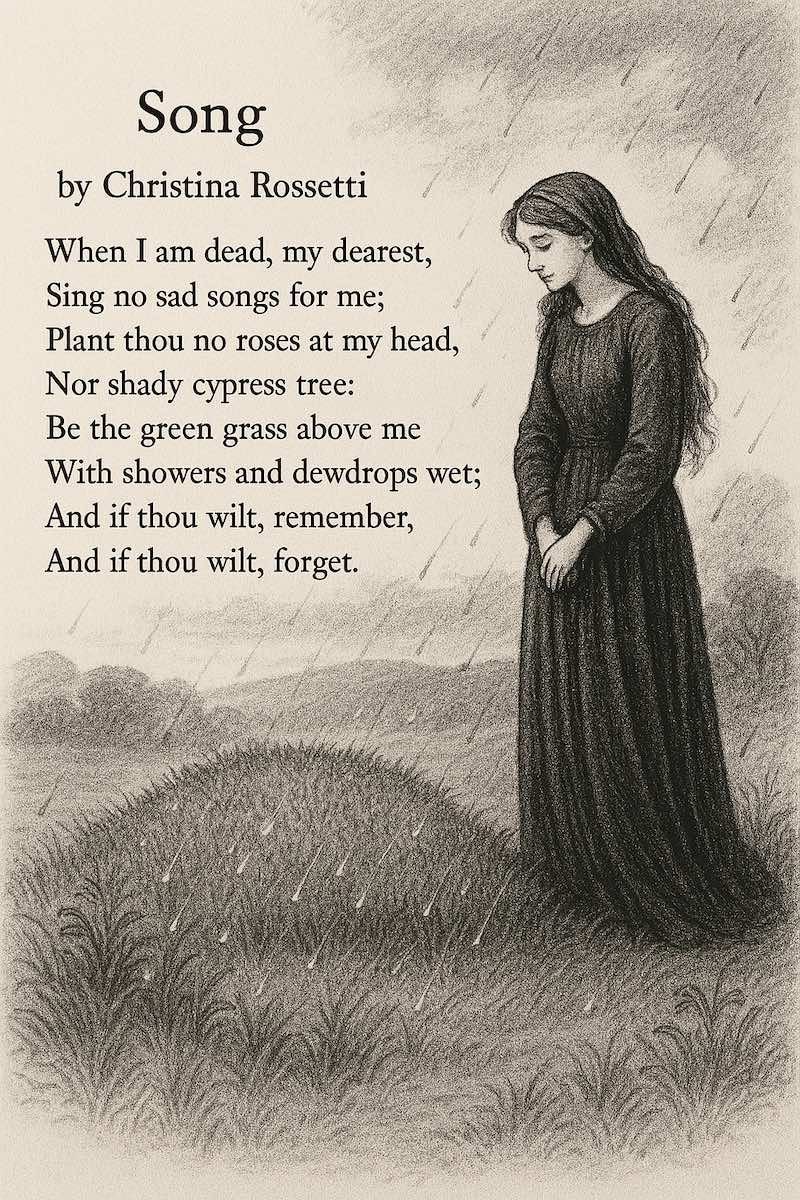
The Poem (Excerpt)
Th
The central "insight" of this stanza is its radical lack of ego. While many elegies seek to ensure the speaker is never forgotten, Rossetti’s speaker grants her loved one the ultimate permission: "And if thou wilt, forget." It suggests that true love does not require the living to remain trapped in perpetual grief, but rather allows them to find peace in whatever way comes naturally.
Rossetti utilizes a deceptively simple structure—an ABCB rhyme scheme—that lends the verse a song-like, lullaby quality. She strips away the conventional, heavy trappings of Victorian death: the "sad songs," the "roses," and the "shady cypress tree." By choosing the "green grass" and "dewdrops" instead, she aligns her final rest with the cycles of the natural world rather than the rigid, somber rituals of human mourning.
The brilliance of this excerpt lies in the final two lines. By repeating the phrase "And if thou wilt," Rossetti places the agency entirely in the hands of the survivor. It is a selfless act of love that removes the guilt often associated with moving on. The poem suggests that "remembering" and "forgetting" are both natural states, and that a peaceful rest is not disturbed by either.