The Singing Silence: Gwendolyn Bennett’s "Quatrain"
Gwendolyn Bennett was a multi-talented artist and writer whose work helped define the aesthetic of the Harlem Renaissance. Her poem "Quatrain," first published in 1927, is a stunning example of her ability to capture complex sensory experiences in an incredibly brief format. In just four lines, Bennett challenges our perceptions of the natural world, making it an ideal selection for The Concise Verse.
The Poem
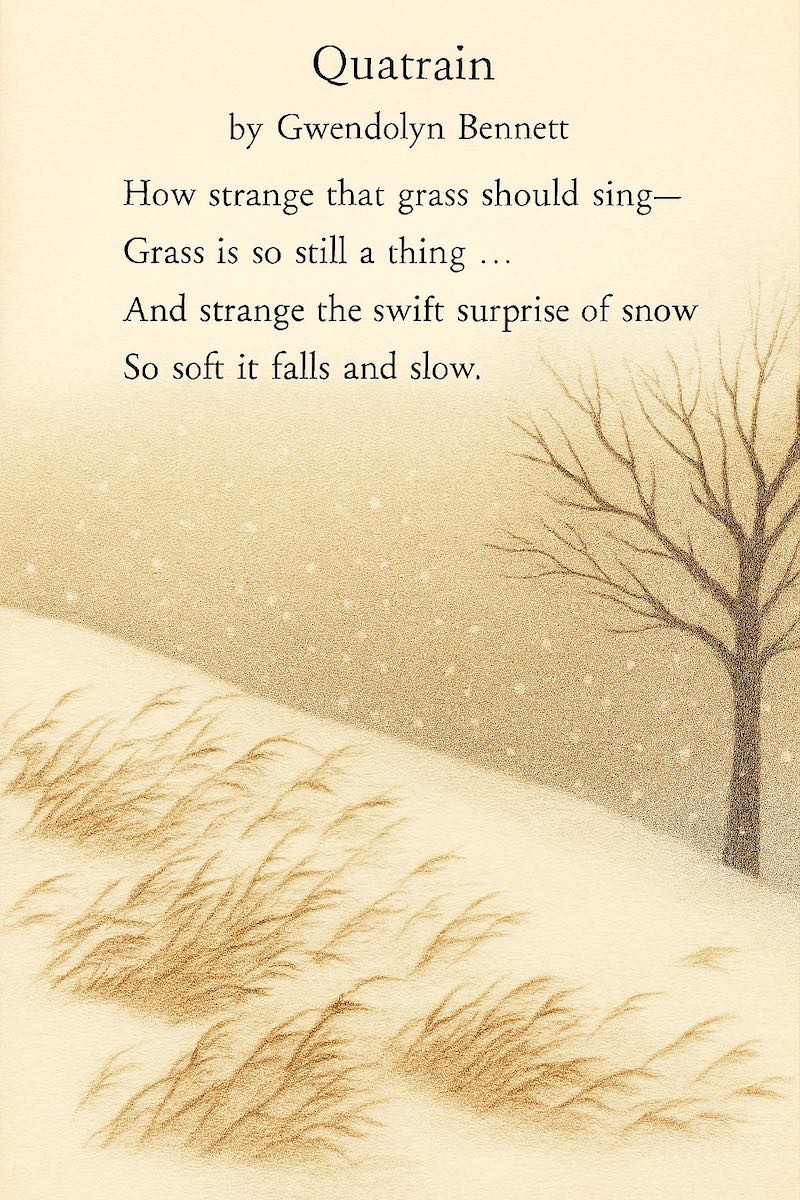
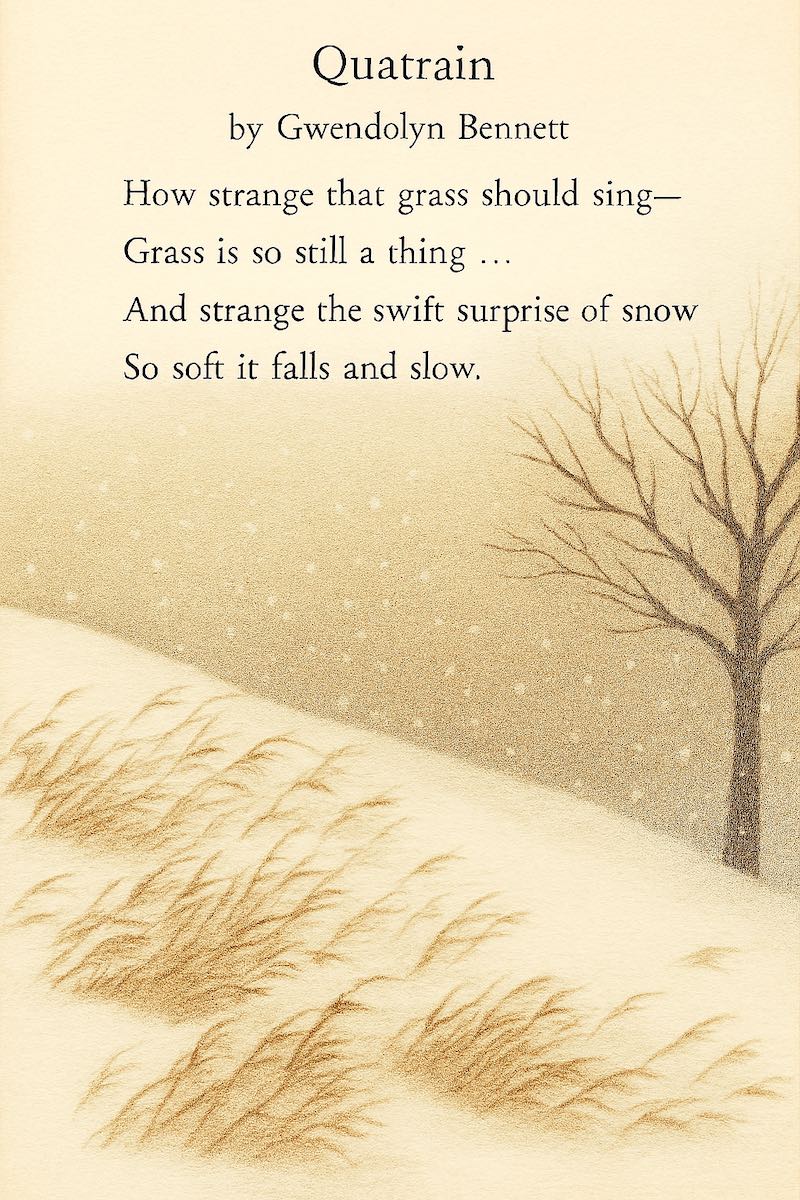
How strange that grass should sing—
Grass is so still a thing . . .
And strange the swift surprise of snow
So soft it falls and slow.
The Insight: The Paradox of the Natural World
The central "insight" of this poem is the revelation of the unexpected in the mundane. Bennett highlights the paradoxes of nature: that which is "still" (grass) can possess a voice, and that which arrives as a "surprise" (snow) can do so with the utmost softness and deliberation. It encourages the reader to look—and listen—more closely to the quietest corners of the earth.
Bennett utilizes the titular quatrain structure—a single four-line stanza—to create a balanced and rhythmic meditation on nature. The poem is built on a series of gentle alliterations, such as the "swift surprise of snow" and "soft... and slow," which mimic the hushing effect of a winter snowfall. The use of the ellipsis in the second line creates a literal "still" moment in the reading, forcing the reader to pause and consider the silent song of the grass.
The rhyme scheme (AABB) provides a sense of completion and harmony, mirroring the perfect order of the natural world. By labeling these natural occurrences as "strange," Bennett is not suggesting they are unnatural, but rather that they are marvelous. She elevates the simplest elements of our environment—grass and snow—into subjects of high poetic wonder, proving that profound beauty does not require expansive length.