The Nearness of Beauty: Finding Light in Sara Teasdale's "Night"
Sara Teasdale is celebrated for her lyrical mastery and profound economy of expression, distilling universal emotion into clear, accessible verse. Her poem "Night", first published in 1930 in her collection Stars To-night, is a stunning example, painting a spare, beautiful landscape of a winter sky and transforming it into a message of accessible joy. This short, perfect lyric is a wonderful fit for The Concise Verse.
The Poem
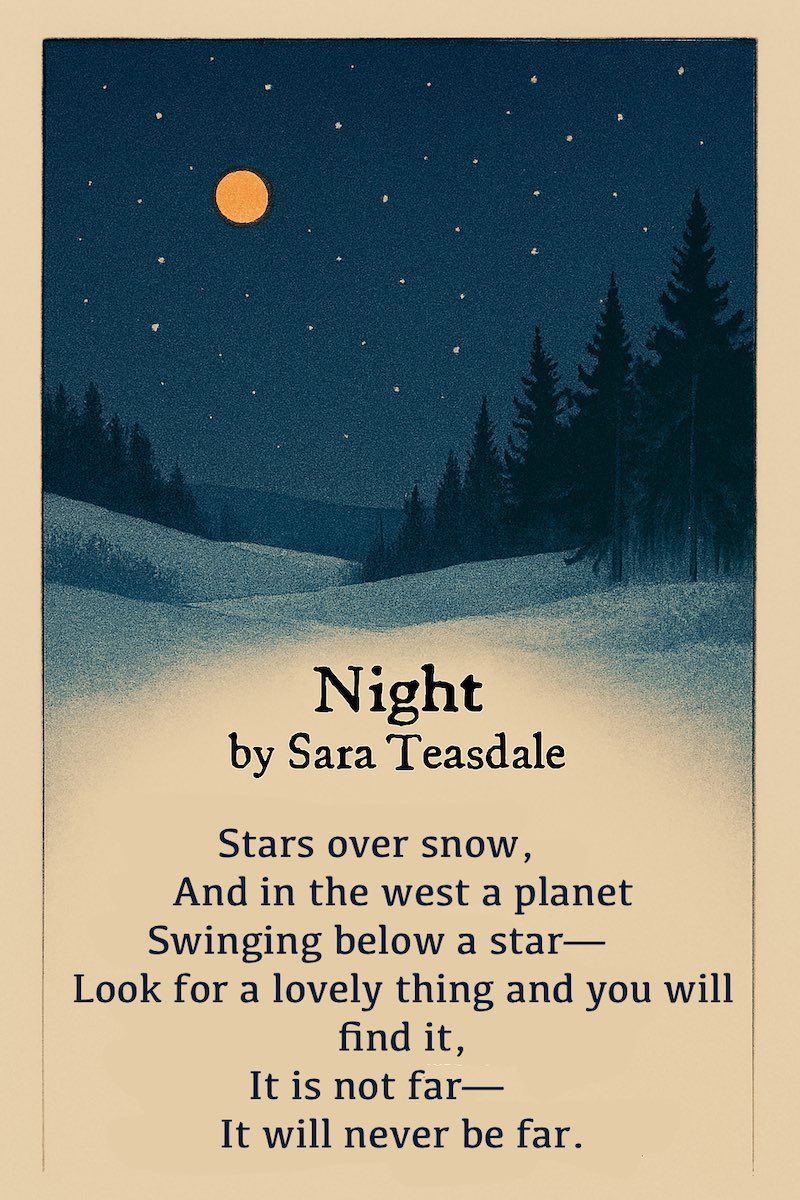
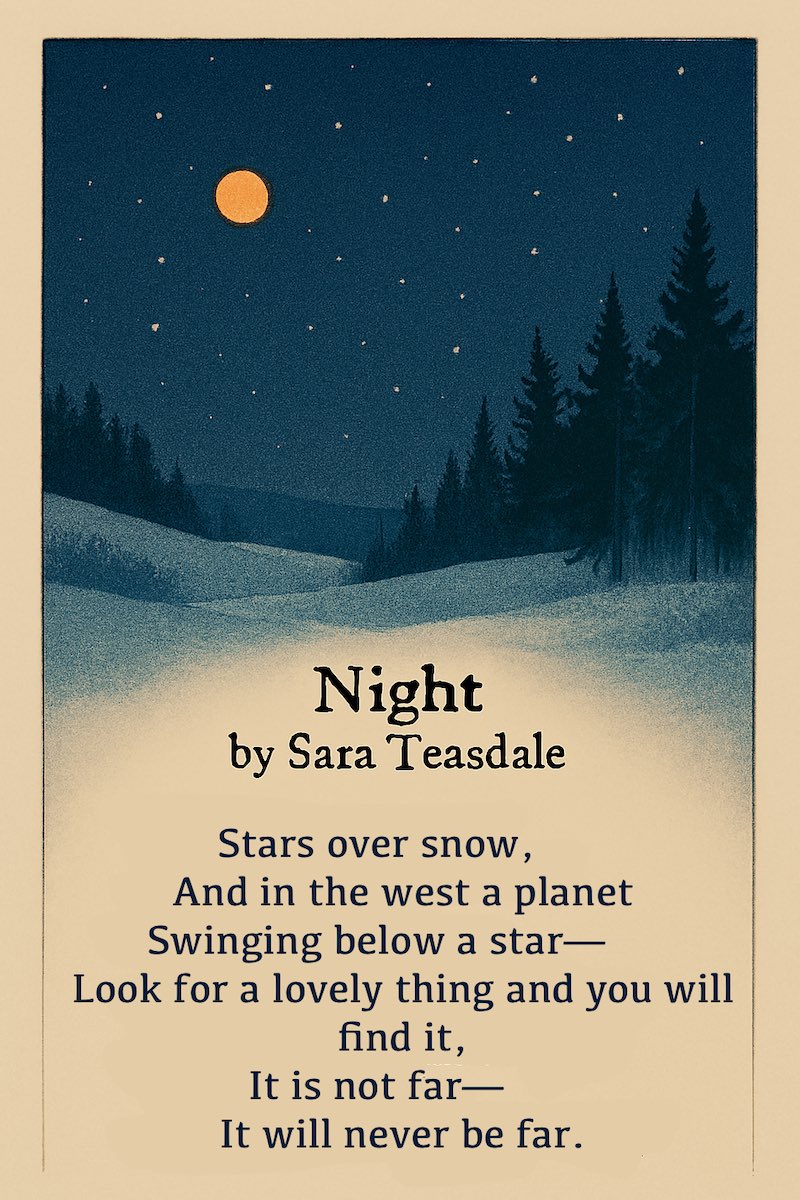
Stars over snow,
And in the west a planet
Swinging below a star—
Look for a lovely thing and you will find it,
It is not far—
It will never be far.
The Insight: The Accessibility of Joy
The poem's power lies in its simplicity and its direct, comforting address to the reader ("Look for a lovely thing..."). The first half sets an elemental scene: "Stars over snow," followed by a specific, almost scientific detail: "in the west a planet / Swinging below a star—". This juxtaposition of the vast, cosmic scale with the intimacy of the speaker's observation grounds the poem's philosophy.
Teasdale, who focused her writing on themes of beauty, love, and death, uses this quiet winter scene as a backdrop for a universal, comforting philosophy. She delivers the core message in the final three lines, which serve as an instruction and a promise. The call to action is direct: "Look for a lovely thing and you will find it,". This is followed by the soothing, double affirmation: "It is not far— / It will never be far". Teasdale achieves maximum impact with minimum word count, using end-rhyme and simple language to give the reader an almost spiritual promise that beauty and solace are perpetually within reach. The poem itself is a concise, perfect lyric that functions as its own proof.