The Relentless Journey: Ralph Waldo Emerson's "Love" Quatrain
First published in his 1867 collection May-Day and Other Pieces, this concise quatrain highlights the transcendentalist philosophy of Ralph Waldo Emerson. As a central figure in the 19th-century American Transcendentalist movement, Emerson’s work often focused on the inherent power of the human spirit and its connection to the natural world. While he penned longer, more complex meditations on the same subject, this brief four-line poem distills the essence of love into a force of sheer, unstoppable will.
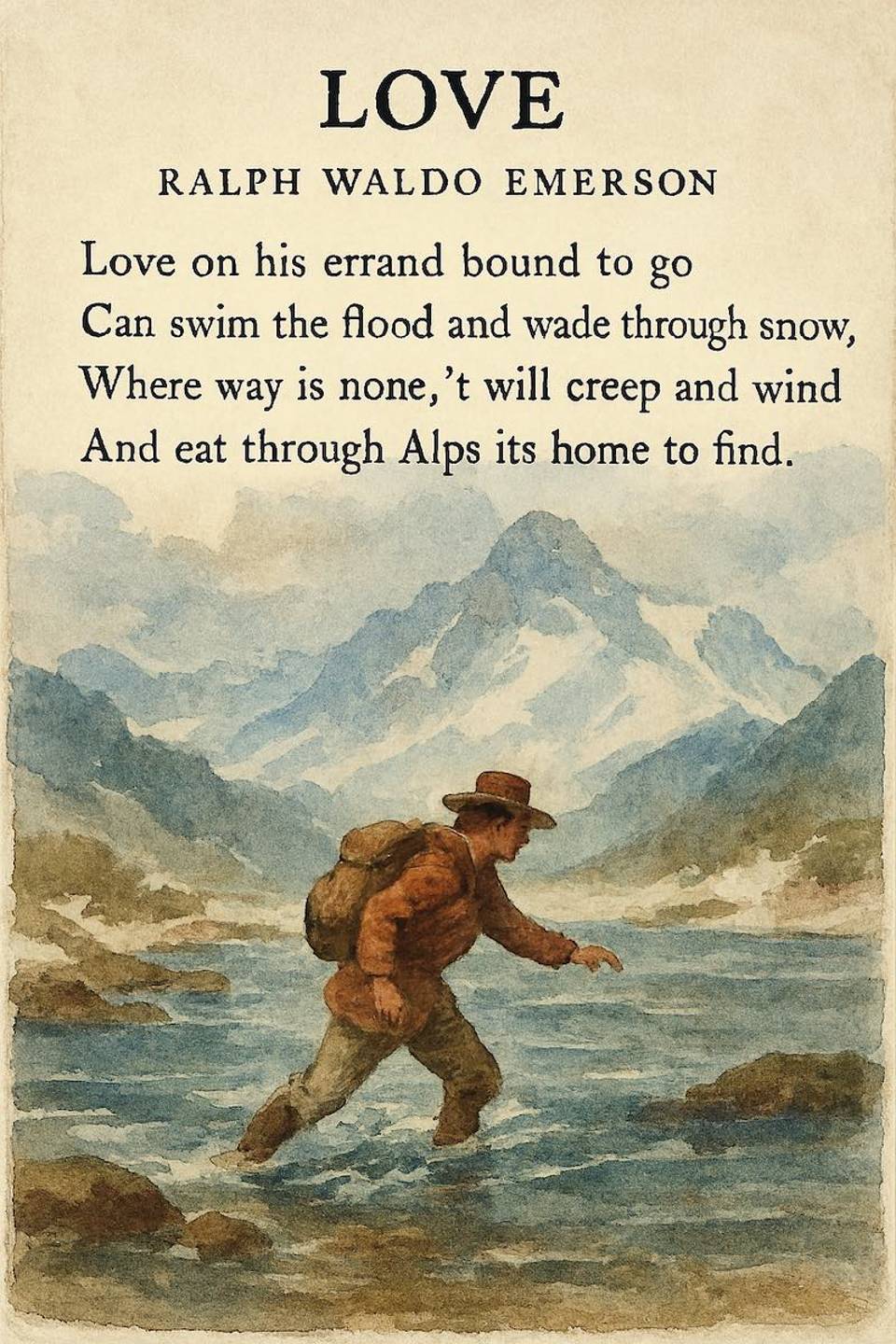
The Poem
Love on his errand bound to go
Can swim the flood and wade through snow,
Where way is none, ’t will creep and wind
And eat through Alps its home to find.
The Insight: The Relentless Journey
The poem offers a powerful summary of love not as a passive feeling, but as an active, relentless traveler. By personifying Love as being "bound" to its errand, Emerson suggests that true affection is a biological and spiritual necessity that overcomes any physical barrier.
Emerson utilizes a series of increasingly difficult physical challenges—floods, snow, and finally the "Alps"—to dramatize the endurance of the spirit. The final line, where Love must "eat through Alps," provides a striking image of persistence; it suggests that love is a force of nature so potent it can erode the most immovable obstacles.
The core philosophical "takeaway" is that love is inherently purposeful. It does not merely wander; it seeks a "home." In the Transcendentalist view, this home is the ultimate realization of unity and truth, a destination that Love will find even when no visible path exists.