The Flower of Time: Frank Dempster Sherman’s "At Midnight"
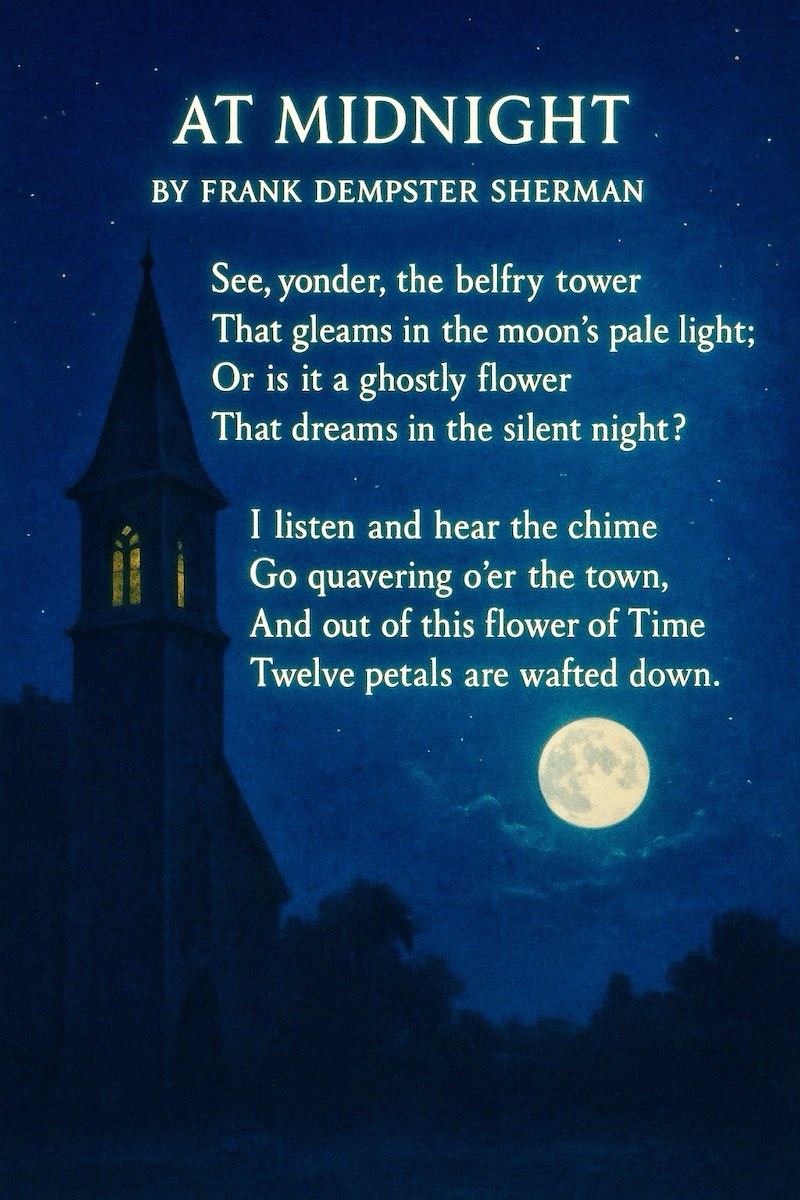
Frank Dempster Sherman was a master of the "lyric" form—short, musical poems that capture a singular emotion or image with crystalline clarity. His poem "At Midnight," first published in 1890 in his collection Lyrics for a Lute, is a perfect example of his delicate touch. In just two stanzas, Sherman transforms the mechanical tolling of a clock into a fleeting, natural wonder, making it a sublime selection for The Concise Verse.
The Poem
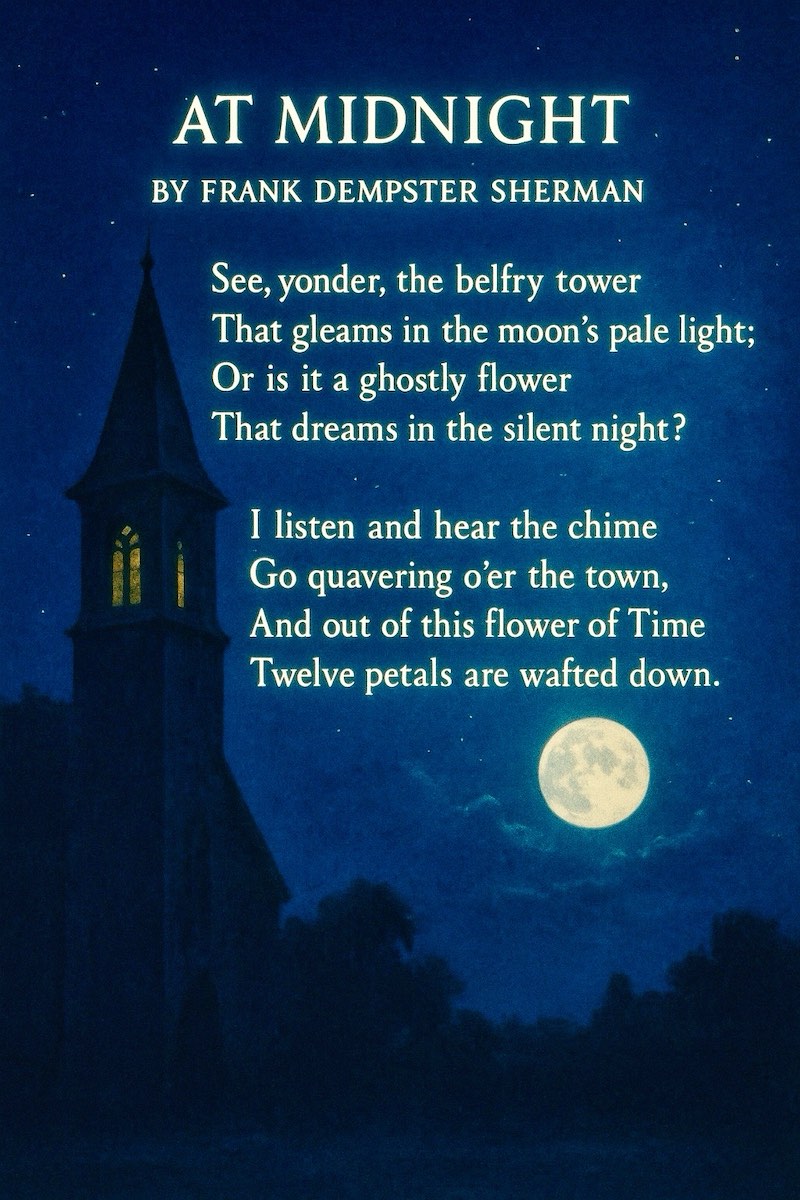
See, yonder, the belfry tower
That gleams in the moon’s pale light;
Or is it a ghostly flower
That dreams in the silent night?
I listen and hear the chime
Go quavering o’er the town,
And out of this flower of Time
Twelve petals are wafted down.
The Insight: The Fragility of the Moment
The central "insight" of this poem is the poetic transformation of time. Sherman asks us to stop viewing time as a rigid, mechanical force and instead see it as something organic and fragile. By envisioning the hour of midnight as a "ghostly flower" losing its petals, he highlights the beauty and the inevitable loss inherent in every passing second.
Sherman utilizes a gentle, swaying rhythm and an ABAB rhyme scheme that mimics the quiet "quavering" of a distant bell. In the first stanza, he uses a beautiful visual metaphor, comparing the moonlit belfry tower to a "ghostly flower." This sets a surreal, dreamlike tone where the solid world of architecture begins to soften into the world of imagination.
The second stanza provides the auditory payoff. The sound of the clock striking twelve is reimagined as "twelve petals" being wafted down. This is a brilliant use of personification and imagery; rather than hearing a loud, metallic gong, we are invited to "see" the sound as something soft, silent, and natural. By calling it the "flower of Time," Sherman suggests that even our most structured measurements of life are subject to the same delicate cycles of blooming and fading as the smallest blossom.